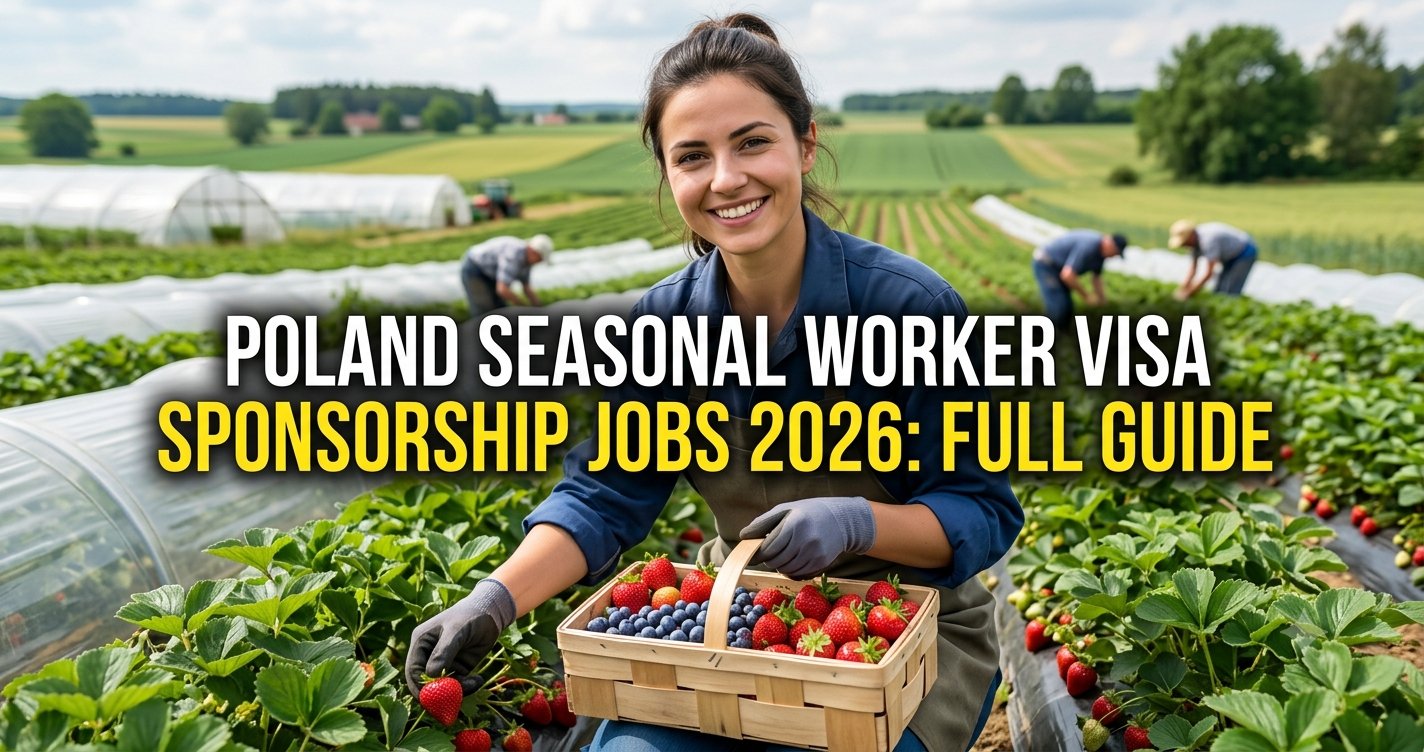
Poland Seasonal Worker Visa Sponsorship Jobs 2026: Full Guide
Carefully incoming an international job market may look intimidating as you begin to resist with the perplexing types of visas, instable immigration rules, and severe documentation chucks. Each year, tens of thousands of workers from non-EU republics (such as India, Nepal, the Philippines, Bangladesh, Vietnam, Indonesia, Georgia and Armenia) relate to work officially and provisionally in Europe. Between the most successful avenues for foreign workers who aren’t able to relocate to other countries is work in Poland, where there are also clearly outlined legal structures in place and which’s employer sponsorship and the structured nature of seasonal working mean that this is usually the most favored option.
The Poland Seasonal Work Visa (Type S) is a visa valid for a one-year period, granted to nationals of countries where the presence of foreigners is required in sectors like agriculture, fruit picking, horticulture, food processing, tourism and hospitality. Much more substantial changes to Polish immigration laws allowed seasonal workers to stay for a maximum of 9 months in each of 12-month rolling periods. This will give worker more financial opportunities and give European employers predictable medium to short-term workers.
Overview of the Poland Seasonal Work Visa (Type S)
The Poland Seasonal Work Visa is a special visa holding a legal structure called a ‘Type S’ seasonal work permit. The seasonal work permit applies to certain industries where workload demand fluctuates through different seasons of the year and are normally seasoned in nature, and is a less complex multi-step market test work permit (Type A).
In Poland, working seasonality is very strictly determined, based on the classifications provided by the Ministry of Family, Labour and Social Policy. During the high production or harvest periods these sectors are highly dependent on the manual, operational and service-based labour.
Key Highlights of the 2026 Poland Seasonal Work Rules
Immigration rules and the labour law is constantly amended to adjust to economic situations and labour market need. RSA A for 2026 is based on significant updates to the Polish seasonal work framework:
Extended 9-Month Maximum Stay Window
Seasonal labors are permitted to work for up to 9 months inside any rolling 12-month period (expanded from the foregoing 6-month limit). This window is considered on a adapted, rolling beginning for each separate worker rather than observing exactingly to a calendar year.
Streamlined Labor Processing
Seasonal work permits have anyways speedy processing when contrasted to multi-year work permits. In the case of seasonal jobs the standard labour market test (Starosta Information) is not required, reducing the waiting time for the employer who is interested in employing foreign labour.
Digital Application Workflows
All business applications submitted in Poland must be submitted electronically via the Government application service portal praca.gov.pl. In addition, the online Case Handling Module (MOS – mos.cudzoziemcy.gov.pl) is utilized by foreign nationals who are temporarily residing in Poland and require the extension of their legal status or deal with immigration issues.
Direct Protection for Foreign Workers
There are explicit provisions in Polish labour law that foreign seasonal workers are paid the same wages as would be paid to local Polish workers doing the same work. Employers must give written contracts of employment to workers in a language they can read and understand before they start their jobs.
Detailed Eligibility & Visa Requirements
The Poland Seasonal Work Visa regulations include the following conditions: Persons wishing to obtain a Poland Seasonal Work Visa must fulfil specific requirements established by both the Polish Labor Office and the Ministry of Foreign Affairs.
Criteria for the Foreign Applicant
- Citizenship: Open to non-EU/EEA nationals universal.
- Age: Aspirants must be at minimum 18 years old at the time of submission.
- Physical Fitness: Many regular roles (especially agricultural gathering) request physical endurance and the skill to perform guide work outdoors or in warehouse situations.
- Clean Legal Record: Claimants must not keep criminal records or transportable bans entering the Schengen Area.
Step-by-Step Guide to Applying for Poland Seasonal Worker Jobs
A seasonal work visa takes both the effort of the foreign’s job searcher and the harmony of the Polish employer. To all the steps one needs to comply to and the common pitfalls they must avoid, follow these steps sequentially.
Find a Sponsoring Polish Employer: Step 1: Application & Selection.
Look for free jobs and search for open positions that are not fake offers; they are advertised via the official Polish Public Employment Service – cbop.kwp.gov.pl), reputable European job portals (EURES, Pracuj.pl) or certified Polish employment agencies that participate in the KRAZ registry .Make sure that employment can be sponsored by the employer
Employer Secures Seasonal Work Permit: Step 2: PUP Registration.
After the selection, the employer registers an application with the closest (PUP) under praca.gov.pl. Required admin fee (PLN 100) is paid by the employer. The PUP registers the application, and then gives an official confirmation certificate, which is needed to receive a seasonal visa.
Receive Employment Contract & Certificate: Step 3: Document Collection.
Employer issues the original or digitally signed certificate together with a formal draft contract with conditions in relation to the work performed: description of duties, salary terms, number of hours, living conditions, etc. Please look through all the terms closely to make sure they are up to the same set of minimum wage requirements as in Poland.
Book Embassy / VFS Appointment: Step 4: Visa Filing.
Book a national visa appointment at institutional VFS Global national web pages appropriate for your country of origin, or at the official e-Konsulat system. Fill out the online visa application carefully with all information, correlating with the information on your work permit certificate and your passport as necessary.
Attend Visa Interview & Submit Biometrics: Step 5: Submission & Processing.
Make an appointment to apply for your assignment in person with all your original paperwork, passport photo copies, travel insurance and administrative fees brought. Typical processing takes 14-30 days depending on the workload of the Embassies during the season.
Travel to Poland & Complete Onboarding: Step 6: Registration.
Please arrive in Poland once you have received your visa. If you reside long term, you have 30 days from your arrival to register your address (zameldowanie) if this was not done when you initially arrived in Poland, and report to your employer and then sign your final contract before doing any work. Your PUP needs to be informed that you are working.
Benefits of Seasonal Employment in Poland
Seasonal employment provides a number of benefits to international candidates who are interested in gaining work experience in Europe:
- Legal Work & Protections Full legal protection provided by Polish employment laws providing safe working environment, equal distribution of wages.
- Simplified Entry Route: As seasonal permits do not have to go through the market labor tests, they are faster to obtain than standard, 3-year, Type A work permits
- Substantial Earning Potential: Seasonal workers can work up to 9 months in a 12-month period with the 2026 extension, compared to 6 months would allow them to earn up to 50%.
- Opportunity to Change Employers: If an agricultural season is short/early, they have a legitimate chance to switch employers during the season, with a new agricultural employer and a new Seasonal Permit.
- Gateway to Future Opportunities: Keep a good immigration record, gain work experience in Europe and your CV will look better and so will your credibility to find future work opportunities in Europe, whether it be seasonal or long-term.
Expert Tips to Secure Genuine Visa Sponsorship Jobs
Given the demand for work visas in Europe, jobs must be sought prudently, and one should go for potential legal work chances.
Leverage Official Government Job Portals
Do not accept any social media posts that promise you a certain visa. Rather, concentrate on advertised government and official job postings:
- CBOP (Centralia Baz Offer piracy): Centralia Bazar Offer Piracy (CBOP), the Polish Ministry of Family and Social Policy’s job portal (cbop.kwp.gov.pl). Provide name of job position where foreign labor is required
- EURES (European Employment Services): The official EU job mobility platform with verified EU employers.
Format Your CV for European Employers
Hundreds of applications are received by Polish employers. Use Europass CV structure to highlight essential information to a European audience:
- Emphasize important aspects of physical stamina, farm apprentice duties, factory machine work or possessing.
- Continue to use brief, meaningful and professional formatting.
- Provide contact details (e.g. (International Country Code) + WhatsApp number / Email).
Communicate Directly with Direct Hiring Employers
As far as possible use directly to the larger Polish agricultural estates, food processing companies and resort establishments, not to a third party sub-agent. Employers process permits efficiently and communicate terms when setup.
Common Mistakes That Lead to Visa Refusals
Knowing about the reasons behind Visa rejection, allows you to take the preventive steps so that your application is not rejected.
- Purchasing Fake Work Permits: Buying from fraudulent agencies will result in immediate rejection of visa and a potential ban in Schengen. Please ensure that official PUP registry numbers are written on your permit.
- Inadequate Insurance Policy: : Insurance for the duration of stay below €30,000, or summation of insurance policy which doesn’t provide appropriate medical repatriation insurance (24 hours hospitalization or up to €30,000) will lead to visa processing delay or denial of a visa.
- Mismatched Personal Information: Inconsistencies in names, between your PAF and work permit passport information, or in birth date information are administrative rejections, not considering your visa application.
- Overstaying Previous Visas: Applications will be automatically marked during consular checks if you have had previous visa for entering into the Schengen Area that has been overstayed. Always abide by visa validity dates.
Also Read : spain-factory-worker-visa-sponsorship-jobs-2026/
FAQs
-
How long does it take to process a Poland seasonal work visa in 2026?
The development commonly takes 4 to 8 weeks in total. Employer process of the seasonal permit at the local effort office typically takes 1 to 3 weeks. Once you accept the permit and submit your visa application at the Polish embassy or VFS center, consular visa dispensation takes almost 14 to 30 days.
-
Can I bring my family members on a seasonal work visa?
No. The Poland Regular Work Visa (Type S) is a provisional short-term work visa intended for seasonal labor. It does not allowance family reconsolidation rights. Family supporters would need to apply for their own self-governing visas to travel rightfully.
-
Does a seasonal work visa lead to permanent residency or a PR card in Poland?
No. Time expended in Poland under a regular work visa does not count toward eternal residency or long-term EU residence wants. The Type S visa is strictly non-immigrant and provisional. However, attainment legal employment history in Poland can style it easier to secure normal long-term employment (Type A permit) in the future.
-
Can I change employers after arriving in Poland on a seasonal visa?
Yes, but you cannot only quit and start working away without paperwork. Your new employer must apply for a different seasonal work permit on your behalf with the local labor office before you start physical work. You must continue within your maximum acceptable 9-month window.
-
Do I need to speak fluent Polish to get a seasonal job?
Basic English or forthcoming Polish is helpful, but confident Polish is hardly mandatory for entry-level seasonal roles in agriculture, gathering, or factory packaging. Most managers provide basic instructions in English or work with multi-lingual team selected.
Final thought
The Poland Seasonal Worker Visa 2026 framework offers a dependable, structured path for non-EU workers looking for seasonal employment crosswise key industries in Central Europe. With the maximum extent extended to 9 months per progressing year, foreign workers have greater opportunity to maximize their earnings while delivering vital support to Polish agriculture, dispensation, and hospitality divisions.
Achievement in obtaining a seasonal job requires early research, strict adherence to official documentation, and commerce exclusively with certified employers and official government channels. By confirming your work permit is officially listed through praca.gov.pl, making an error-free consular application, and accepting your rights under Polish work law, you can achieve a creative and legally compliant work stay in Poland.