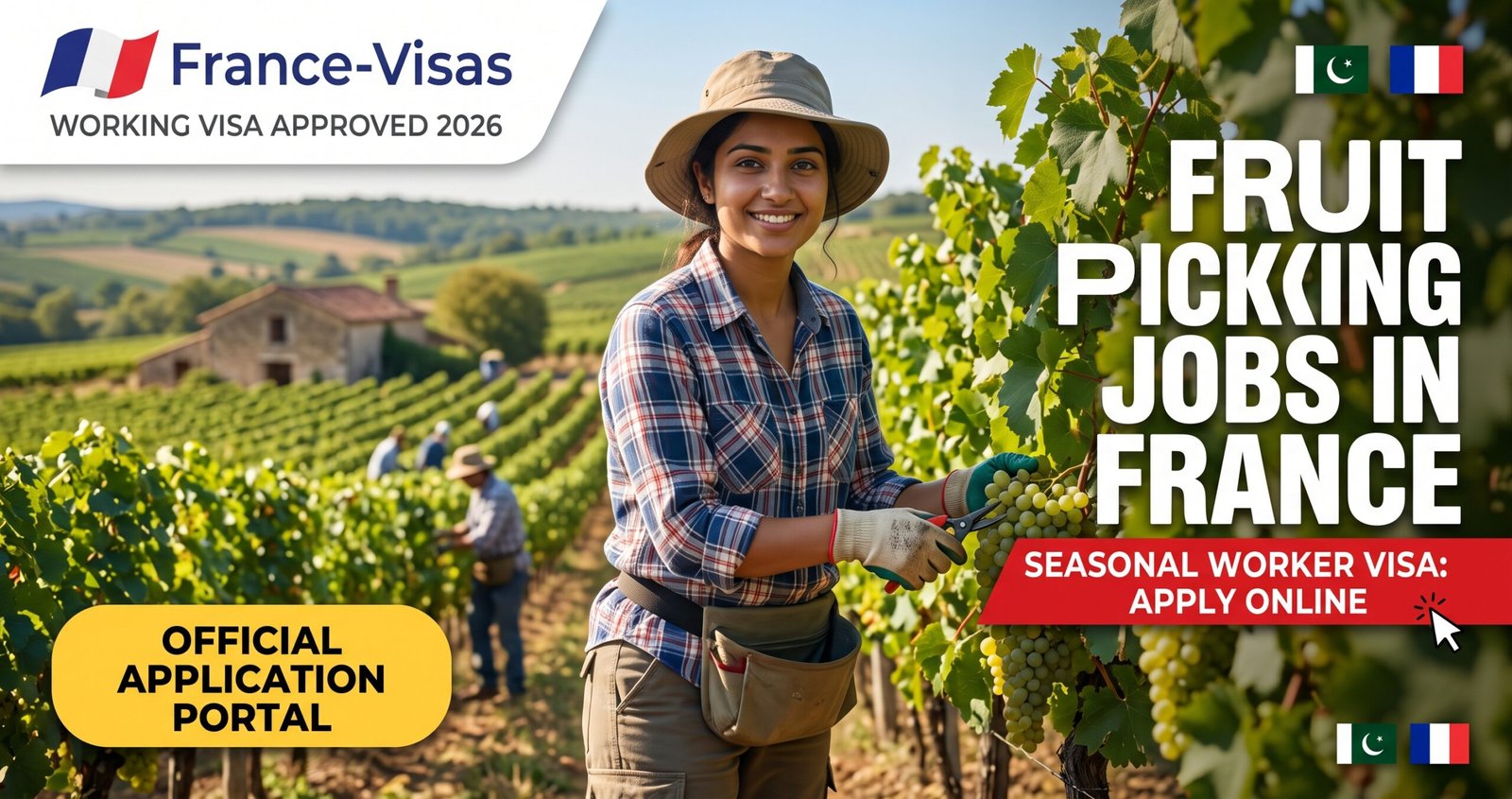
Fruit Picking Jobs In France with Seasonal Worker Visa: Apply Online
One of the highest priorities for international employment seekers, students and seasonal workers in Europe is to find legal and lucrative jobs in agriculture. Even though France has stringent restrictions on employing foreign adult labor, the country continues to be one of the world’s leading agricultural producers and foreign labor is still hired to work in its extensive orchards, vineyards, and berry fields during harvest.
The first Steps on the application process, legal procedures and the visa can be daunting if you don’t know your way around. This extensive and step-by-step explanation covers everything you have to know about the successful placement of a fruit picking visa implemented in France in 2026. Learn about the harvest schedules, verified application portals, official visa documents, worker rights, wage rates and tips for a safe and successful harvest season in France.
Overview: The French Agricultural Sector in 2026
In addition to the stone fruits and light berries of the valleys in the South of France, the country has extensive acreages of apples in the West and famous estates of vineyards throughout. Automation does not replace manual harvesting since fresh fruit has to be handled delicately and correctly to prevent bruising. Agricultural workers who immigrate here to work in the field (salariés saisonniers) are used extensively each year by French farmers to harvest crops at their optimum ripeness.
The French government and agribusiness close their eyes together to keep regulated immigration routes. The Seasonal Worker Visa (Visa de Long Séjour valant Titre de Séjour – VLS-TS Saisonnier) is a solution to legalize and regulate the entry of non-EU/EEA/Swiss nationals to undertake work with a licensed company in an agricultural sector for whom they are appointed, wherein they can work under a right guaranteed by French law and rights, with a standard statutory wage.
Key Highlights of the Seasonal Worker Visa
The French Seasonal Worker Visa suggestions a clear permitted status considered specifically for temporary employment agreements in sectors like agriculture, viticulture, and gardening.
| Feature | Details |
| Visa Category | Long-Stay Seasonal Worker (VLS-TS Saisonnier) |
| Permitted Duration | Up to 6 months within any successive 12-month rolling old-fashioned |
| Multi-Year Validity | Can be delivered for up to 3 years, permitting return visits each produce season (max 6 months/year) |
| Official Work Authorization | Must be demanded online by the French employer via the Department of the Internal (DREETS) |
| Statutory Minimum Wage (SMIC) | Certain minimum rate of €12.31 gross per hour (based on the normal 35-hour workweek) |
| Family Accompanying | Not acceptable under this detailed seasonal grouping |
France Fruit Harvest Calendar: Crops, Regions, and Timelines
For getting a job it’s important to match the work with the local harvesting times. In France, the windows in which farmers recruit weeks to months before the picking window
Spring Crops: Strawberries, Asparagus, and Cherries (April to July)
The agricultural year pleasures off strongly in southwestern districts such as Nouvelle-Aquitaine and the Loire Valley. Strawberries want delicate picking and greenhouse work, while cherry orchards in the Rhône Valley and Provence demand agile workforces comfortable on steps and picking platforms.
Summer Fruits: Peaches, Apricots, Melons, and Plums
Occitan, Provence-Apes-Côte d’Azur, and the South of France involvement peak request during mid-summer. Working with melons, nectarines, and rewards involves ground picking, classifying, sorting, and pack in temperature-regulated pack houses.
Late Summer to Autumn: The Great Grape Harvest
The grape produce is the most intensive seasonal employer in France. Major wine regions—plus Champagne, Bordeaux, Burgundy, Alsace, and the Loire Valley—hire tens of thousands of pickers (coupeurs) and crate exporters (porteurs). While the spell is relatively passing (often 2 to 4 weeks per plantation), it is fast-paced, social, and frequently offers on-site lodging and suppertimes.
Autumn to Early Winter: Apples, Pears, and Chestnuts
Normandy, Brittany, Pays de la Loire, and the alpine basins harvest millions of tons of stand apples and cider apples through late end. Apple gathering provides longer, fixed seasonal contracts covering 6 to 10 weeks.
Working Conditions, Wages, and Worker Rights
Under French law, foreign seasonal workers on a valid agreement enjoy the same labor rights, health safeguards, and least possible wage securities as French inhabitants.
Statutory Minimum Wage (SMIC)
All agricultural personnel must accept at least the Salaried Minimum Inter professionnel de Croissance (SMIC).
- Gross Hourly Rate: €12.31 per hour
- Standard Monthly Gross (35-hour week): Almost €1,867.02
- Net Take-Home Pay: After normal social security conclusions, net incomes normally range from €1,450 to €1,550 per month for normal hours.
Overtime and Working Hours
For legal reasons, the working week in France is 35 hours. Weather conditions may force long working hours during the peak harvest period.Harvest peaks may necessitate long hours due to weather. Under French law, overtime is tightly controlled:
- Overtime hours among 36 and 43 hours per week accept a minimum +25% pay premium.
- Hours outside 43 hours per week accept a +50% pay premium.
- Maximum occupied hours cannot outstrip 10 hours per day or 48 hours in a single week without special labor inspectorate derogations.
Social Security, Healthcare, and Workplace Insurance
Your French employment agreement mechanically registers you with the Mutualité Sociale Agricole (MSA), the agricultural social security scheme. This provides coverage for workplace injuries, emergency healthcare, and basic medical needs during your contract duration.
Eligibility Requirements for Foreign Applicants
Before relating online to farms or missions, verify that you chance the standard wants:
- Age Requirement: You obligation be at minimum 18 years old at the start date of the contract.
- Valid Passport: Your passport obligation be effective for at least 3 to 6 months outside your proposed return date, with at smallest two blank visa pages.
- Physical Fitness: Fruit option involves vertical, lifting bangers (often 15–20 kg), indirect, and working outside in variable weather situations.
- Clean Record: A clear illegal background checked may be demanded during the embassy visa selection.
- Signed Seasonal Contract: A valid Contract de Travail Saisonnier with an employer showed in France.
- Approved Work Permit (Authorization de Travail): Supplied by the French Department of the Inside via the employer’s official proposal.
Step-by-Step Guide: How to Apply Online and Secure Your Visa
The sequence is prepared in a structured manner. The first step is to get a job and then apply for the visa.
Step 1: Search and Apply for Seasonal Openings
Apply directly to agricultural websites in France and cooperatives and farms themselves. Make sure your CV is written correctly according to the French model (CV en Français), stating the availability, physical strength and any previous work on the farm, in the warehouse or with manual work.
Step 2: Sign the Employment Contract (Contrat Saisonnier)
Once an application is successful, the farm will make you an actual seasonal contract with your role, pay rate, working hours, start and end dates and housing options covered.
Step 3: Employer Requests Work Authorization (Autorisation de Travail)
Your contract information is sent to the French labor website (Administration des Strangers en France – ANEF). The local labor market is examined by the labor authorities, they then grant a digital authorization document (Authorization de Travail dematerialize).
Step 4: Complete the Online Application on France-Visas
Once you have your work permit approved, go to the official France-Visas webpage (france-visas.gouv.fr).
- Fill in your application and choose the visa category, Long-Stay Visa – Seasonal Worker.
- Enter your own details (hiring reference numbers, passport details etc.).
- Print out the visa application form and visa/preparation checklist.
Step 5: Book and Attend Your Visa Appointment
Program an appointment at the next-door authorized visa application center (such as VFS Global, TLScontact, or the French embassy in your country). Stand up to your physical record, including:
- Finalized France-Visas request form.
- Valid passport and duplicates of former visas.
- Accepted Autorisation de Travail.
- Signed seasonal service contract.
- Evidence of space (hotel, farm quarters, charge lease, or host statement).
- Passport photographs conference EU biometric values.
- Visa dispensation fee payment reception.
Step 6: Arrival and Registration in France
Upon entrance in France with your impressed visa, you obligation validate your visa complete the OFII (Office Français de l’Immigration et de l’Intégration) online platform within the timeframe detailed on your visa certification.
Common Mistakes to Avoid When Applying
- Applying Too Late: Countless top granges confirm their harvest teams 2 to 4 months already picking starts. Late requests often find schedules full.
- Paying Fees for a Job Offer: Real French employers never responsibility employment fees. Never send change via wire transfer for a job agreement.
- Submitting Non-Standard CVs: Ensure your restart is concise, factual, and interpreted into clean French where potential.
- Traveling on a Tourist Visa to Work: Working without a valid work convention and seasonal work visa is illegal and centrals to deportation and entrance bans.
- Ignoring Rural Transport: Various farms are in inaccessible countryside locations without public transit. Explain transport options with your employer earlier.
Also Read : germany-agriculture-jobs-for-foreigners-2026/
FAQs
-
Do I need to speak fluent French to get a fruit picking job?
No, fluency is infrequently mandatory for guide harvesting. However, scholarship basic French phrases for safety guidelines, numbers, and tool names helps you integrate and join with team leaders.
-
Can I renew or extend my Seasonal Worker Visa?
The seasonal visa consents a maximum of 6 months of work per progressing 12-month period. If your multi-year seasonal card is decided, you can return each year throughout the harvest season without submitting a completely new starting point file.
-
Can my family travel with me on this visa?
No. The seasonal worker category does not provision family recombination or dependent visas. Family members requiring to visit must succeed independently under normal tourist or visitor rules.
-
How much money can I save in a season?
Earnings be contingent on total hours worked, actively, and housing incidentals. A worker completing a 3-month produce schedule occupied 35 to 42 hours per week often saves between €2,500 and €4,500 net, conditional on lifestyle and place costs.
Final Thought
Working a fruit picking season in France is a applied way to earn constitutional European wages, gain agricultural experience, and discover French countryside culture actual. Success comes down to early training: mark the correct harvest seasons, use official stands like ANEFA and France Travail, and comprehensive your visa steps carefully through France-Visas. Start your outreach today to protected your contract gaining of the upcoming harvest rush.
1 thought on “Fruit Picking Jobs In France with Seasonal Worker Visa: Apply Online”