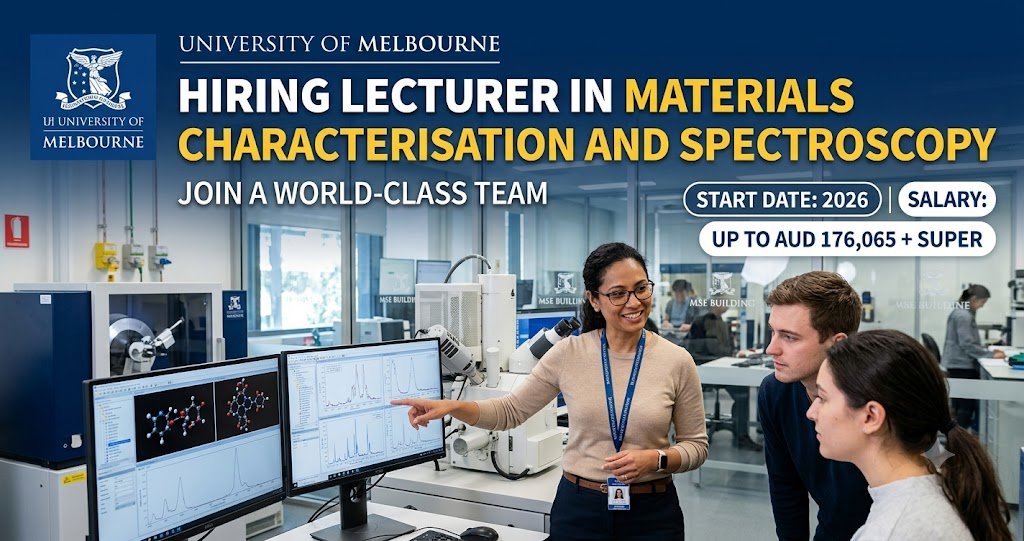
Lecturer in Materials Characterisation and Spectroscopy Job Overview
The University of Melbourne has announced an exciting academic opportunity for a highly qualified researchers and educators who are seeking to advance their careers in a chemistry, materials science, and spectroscopy. The institution is recruiting a Lecturer in the Materials Characterisation and Spectroscopy within its renowned School of Chemistry, with offering a continuing full-time position in one of most respected research and teaching environments in the Australia. This opportunity is particularly attractive for a candidates who possess a strong background in an advanced techniques of a materials characterization, spectroscopy, microscopy, and interdisciplinary scientific research. As the global demand have continues to grow for an experts who are capable of investigating a material properties at the molecular and atomic scales, universities are increasingly investing in a cutting-edge infrastructure of research and talented academics who can drive an innovation. This position have reflects that commitment by providing an access to the world-class instrumentation, extensive facilities of research, and opportunities to establish an independent program of research with a significant international impact. Beyond research responsibilities, the successful applicant will contribute to undergraduate and postgraduate teaching while mentoring the next generation of a chemists and materials scientists. The role have also includes an opportunities to secure a competitive research funding, develop the collaborations with an industry partners, publish influential scientific findings, and participate in a broader academic leadership activities. For researchers who are seeking a long-term academic career in Australia, this position have represents a rare opportunity to combine a teaching excellence, research innovation, and professional development within a globally recognized institution.
About the University of Melbourne
The University of Melbourne is widely recognized as one of leading research-intensive universities in the Australia and enjoys a strong international reputation for an academic excellence, innovation, and societal impact. Established in the nineteenth century, the university has consistently remained at the forefront of a scientific discovery, attracting a talented students, researchers, and members of faculty from around the world. Its commitment to delivering a high-quality education and groundbreaking research has helped to position the institution in among the most respected universities as globally. Within the scientific community, the university is particularly renowned for its contributions to a chemistry, physics, engineering, medicine, environmental science, and emerging interdisciplinary fields. The Faculty of Science have plays a central role in advancing these achievements by fostering a collaboration in across the disciplines and investing as heavily in a modern research infrastructure. Students and academics benefit from an access to the advanced laboratories, sophisticated instrumentation, industry partnerships, and international research networks that enhance both teaching and scientific discovery. The School of Chemistry, where this lecturer position is based, has developed a long-standing tradition of excellence in education and research. Over the decades, the school has produced an influential scientific contributions while maintaining a strong connections with an academic institutions, government agencies, and private-sector organizations in worldwide. By joining the University of Melbourne, the successful applicant will become part of a vibrant academic community which is dedicated to solving a global challenges through the scientific innovation, critical thinking, and collaborative research.
Why This Academic Opportunity Stands Out in 2026
Competition for a high-quality academic positions have continues to increase as globally, with making the opportunities at leading universities as particularly valuable. What distinguishes this Lecturer in Materials Characterisation and Spectroscopy role is the combination of a research freedom, institutional support, opportunities of teaching, and resources of a career development that are available to the successful candidate. Unlike many academic positions that have focus as heavily on either teaching or research, this role have provides a balanced environment where both an areas are equally valued and supported. The university is seeking an individual capable of developing an independent agenda of research while also contributing as meaningfully to undergraduate and postgraduate education. Access to an advanced spectroscopy and facilities of microscopy have allows a researchers to pursue an innovative scientific investigations that may not be possible in an institutions with the limited infrastructure. Furthermore, the university have encourages an interdisciplinary collaboration, with enabling the academics to work with experts in the engineering, biology, physics, environmental science, and other related fields. Such a collaborations have often lead to impactful discoveries, competitive grant funding, and increased visibility of research. Another significant advantage of this opportunity is the emphasis on a progression of career and development of leadership. Academic staff are encouraged to build a national and international profiles of research, participate in professional development programs, and engage with the industry stakeholders to expand the impact of their work. These factors have collectively make this position as one of the most attractive chemistry and materials science academic opportunities that are currently available in Australia.
The School of Chemistry and Its Research Excellence
The School of Chemistry at the University of Melbourne has earned an outstanding reputation for both the teaching and scientific research. As one of largest chemistry schools in the Australia, it have serves a thousands of the undergraduate students while supporting a substantial community of the honours, master’s, and doctoral researchers. The research portfolio of school have spans a numerous scientific disciplines, with including the materials chemistry, chemical biology, analytical chemistry, physical chemistry, organic chemistry, and theoretical chemistry. This breadth of an expertise will creates an intellectually stimulating environment whaere an interdisciplinary collaboration is actively encouraged and often leads to an innovative discoveries. Researchers within the school have an access to the sophisticated analytical instruments, advanced platforms of microscopy, spectroscopy facilities, and computational resources that support a cutting-edge scientific investigations. Many research groups have operate at the intersection of a chemistry with the engineering, physics, biology, and environmental science, with enabling the academics to address a complex challenges that have require a diverse scientific perspectives. The school’s success in attracting an external research funding that further demonstrates its reputation for an excellence and innovation. Funding from an agencies of government, industry partners, and international collaborations will helps to sustain ambitious research programs and supports the development of a new technologies and scientific methodologies. For the successful lecturer, joining this dynamic environment of research have offers an opportunities to establish a strong profile of research, supervise talented students, publish the influential findings, and contribute to the advancement of knowledge in materials characterisation and spectroscopy.
Key Responsibilities of the Lecturer Position
The Lecturer in Materials Characterisation and Spectroscopy will undertake a diverse range of responsibilities which is designed to support the teaching of university, research, and engagement missions. A major component of the role have involves establishing and leading an independent program of research as focused on the advanced materials techniques of a characterization and spectroscopy-related investigations. The successful candidate will be expected to publish a research findings in a high-impact peer-reviewed journals while pursuing a competitive opportunities of research funding from the national and international agencies. In an addition to conducting innovative research, the lecturer will contribute to undergraduate and postgraduate teaching across chemistry-related subjects. This includes preparing lectures, developing learning materials, conducting laboratory sessions, assessing a performance of student, and ensuring that a high educational standards are maintained. Supervision of honours, master’s, and doctoral students have also forms an important part of the position, requiring the mentorship, academic guidance, and support throughout the process of research. The role have further involves a participation in the committees of university, academic planning initiatives, and collaborative projects that have contribute to the broader objectives of the School of Chemistry and Faculty of Science. Industry engagement is another significant aspect of the position, as the university have encourages a researchers to build the partnerships that enhance a research impact and create opportunities for a transfer of knowledge. Collectively, these responsibilities will provide a comprehensive academic pathway of career that have combines a scientific discovery, education, leadership, and community engagement.
Required Qualifications and Professional Skills
The University of Melbourne is seeking a candidates who possess a strong academic background as combined with the demonstrated research excellence. Applicants must hold a PhD in the Chemistry or a closely related discipline as relevant to the materials characterisation and spectroscopy. Beyond formal qualifications, the university is looking for a researchers who have already established a record of the scholarly achievement through a peer-reviewed publications, presentations of conference, collaborative projects, and scientific contributions that have demonstrate the potential for a future research leadership. Candidates should be capable of independently designing and managing a projects of research while effectively communicating a scientific findings to both the specialist and non-specialist audiences. Experience in preparing a research grant applications is highly desirable because securing an external funding is an important component of academic success on long-term. Teaching experience is equally valuable, particularly the ability to deliver an engaging lectures, supervise the laboratory classes, mentor students, and contribute to a development of curriculum. Strong interpersonal and communication skills are essential because the academics have regularly collaborate with a colleagues, industry partners, funding agencies, and students from a diverse cultural and professional backgrounds. The university have also values a professionalism, research integrity, inclusiveness, and a commitment to fostering a supportive academic environment. Applicants who demonstrate both a scientific excellence and educational leadership will be particularly competitive for this prestigious position.
Research Opportunities in Materials Characterisation and Spectroscopy
One of the most attractive aspects of this position is the opportunity to develop a world-class research program in the characterisation and spectroscopy of materials. Modern materials research will plays a critical role in addressing the global challenges as related to the storage of energy, sustainability, environmental protection, technologies of healthcare, advanced manufacturing, and electronic devices. Researchers who are working in this field will investigate the structure, properties, and performance of a materials with using a sophisticated analytical techniques that have reveal an information at the molecular, atomic, and nanoscale levels. The successful lecturer will have an access to the extensive instrumentation that have supports investigations into the material composition, structural dynamics, chemical interactions, and functional performance. Areas of a specialization may include the ultrafast laser spectroscopy, confocal fluorescence microscopy, Raman spectroscopy, and other advanced methods of characterization that are used to study a complex systems of materials. By leveraging these resources, the successful candidate can pursue an innovative projects that have contribute to a scientific knowledge while addressing a real-world technological challenges. Interdisciplinary collaboration is strongly encouraged, with enabling the researchers to work as alongside experts in an engineering, physics, biology, medicine, and environmental science. Such a collaborations have often lead to a breakthrough discoveries, increased opportunities of funding, and stronger visibility of an international research. This environment will provides an ideal platform for the ambitious scientists who are seeking to build an influential and impactful research careers.
Teaching and Student Supervision Responsibilities
Teaching excellence have remains a central component of academic life at the University of Melbourne. The successful lecturer will contribute as significantly to an undergraduate and postgraduate education by delivering a high-quality instruction that prepares the students for a careers in the science, research, industry, and academia. Responsibilities may include designing a course materials, presenting the lectures, conducting a tutorials, overseeing the activities in laboratory, and assessing a performance of student with using a modern educational practices. Effective teaching have extends as beyond the classroom and involves inspiring a curiosity, encouraging the critical thinking, and helping the students to develop a practical scientific skills that can be applied in a professional settings. Student supervision is another key responsibility as associated with this position. The lecturer will guide a honours, master’s, and PhD candidates through all the stages of their research projects, with including a project planning, experimental design, data analysis, scientific writing, and preparation of publication. Mentorship will plays an essential role in developing the future scientists, and the university have places a strong emphasis on creating the supportive environments of learning where students can achieve their academic and professional goals. Through these educational activities, the successful candidate will contribute as directly to the development of the next generation of a researchers while enhancing the reputation of university for an academic excellence.
Salary, Benefits and Employment Package
This academic position have offers a highly competitive package of salary that have reflects the experience, qualifications, and achievements of the successful applicant. Depending on a appointment level, salaries range from an approximately AUD 124,656 to AUD 176,065 per year, with the additional contributions of a superannuation and employment benefits. Such a compensation have places the role in among the more attractive academic opportunities that are available within the higher education sector of Australia. However, the value of this position have extends as beyond a salary alone. Employees benefit from a comprehensive professional support, access to the advanced research infrastructure, career development opportunities, and a workplace culture that promotes innovation and wellbeing. The university have invests as heavily in its academic staff because it recognizes that talented researchers and educators are essential to achieving institutional success. Financial security, research support, and professional growth opportunities will collectively create an environment where the academics can focus on an impactful teaching and research rather than administrative or resource limitations. For an international applicants and experienced researchers who are seeking a career stability on long-term, the overall package of employment have represents a compelling combination of the financial rewards and opportunities of a professional development.
17% Superannuation and Additional Employee Benefits
One of the most significant advantages of an employment at the University of Melbourne is the generous superannuation contribution which is provided to an eligible staff. The university have contributes a 17% superannuation, a figure that have exceeds many standard arrangements of a retirement contribution and significantly enhances the long-term financial security. Over the course of an academic career, this additional contribution can have a substantial positive impact on the retirement savings. Beyond a superannuation, staff members have an access to a broad range of benefits as designed to support the professional and personal wellbeing. Flexible arrangements of work will help the employees to maintain a healthy work-life balance while accommodating the individual circumstances and professional responsibilities. Professional development programs have allow the academics to strengthen a leadership, teaching, research, and management skills through workshops, mentoring initiatives, and online platforms of learning. Employees may also benefit from an opportunities of salary packaging, discounted services, health and wellbeing programs, counselling support, and various recreational and cultural benefits. These initiatives that have reflect the commitment of university to creating an inclusive workplace where the employees can thrive both as professionally and personally.
Visa Sponsorship and Opportunities for International Applicants
The University of Melbourne have welcomes an applications from talented researchers and educators around the world and has confirmed that this position is eligible for a visa sponsorship. This is particularly important because many highly qualified academics seek an opportunities to contribute to the Australian higher education while advancing their international careers. Visa sponsorship have demonstrates the commitment of university to attracting a global talent and building a diverse academic community as enriched by the different perspectives, experiences, and areas of an expertise. International applicants who meet the required qualifications can apply with a confidence in knowing that support will be available throughout the process of immigration if they are selected for the role. Australia have continues to be one of the most attractive destinations in world for an academic professionals due to its high-quality universities, environment of a strong research funding, excellent standard of the living, and multicultural society. By joining the University of Melbourne, international academics will gain an access to a global networks of research, advanced facilities, and opportunities for a career growth on long-term within a highly respected educational system. This have makes the position as particularly appealing for a researchers who are seeking both a professional advancement and an exceptional quality of life.
Career Development and Research Funding Opportunities
Academic success have increasingly depends on a access to the funding, collaboration, mentorship, and institutional support. The University of Melbourne have actively supports a staff members in building a successful careers on long-term through the structured initiatives of development and extensive research support services. Academics are encouraged to pursue a competitive grants from the national and international funding agencies while establishing collaborations with the industry, government organizations, and research institutions worldwide. These opportunities have enhance a productivity of research while increasing the impact and visibility of a scientific work. The university have also offers a leadership development programs, mentoring the initiatives, and opportunities of networking that help the staff members progress toward a senior academic and administrative positions. Researchers who demonstrate an excellence in the scholarship, teaching, and engagement can build influential careers that contribute significantly to both their discipline and society. For early-career and mid-career academics, access to these resources can accelerate a professional growth while supporting the development of internationally recognized research programs.
Living and Working in Melbourne, Australia
Melbourne is widely regarded as one of the most livable cities in the world and consistently ranks as highly in the international quality-of-life assessments. The city have offers a vibrant cultural environment, excellent public services, diverse communities, and a strong economy that have supports an innovation, education, and research. Academics who are working in Melbourne have benefit from an access to world-class healthcare, educational institutions, public transportation systems, recreational facilities, and cultural attractions. The city’s multicultural character that have makes it as particularly welcoming for an international residents, while its thriving scientific and technology sectors provide an extensive opportunities for the professional networking and collaboration. Melbourne’s reputation as a global education hub have further enhances its attractiveness for a researchers and educators seeking dynamic and intellectually stimulating environments. These factors have contribute as significantly to the overall appeal of the Lecturer in Materials Characterisation and Spectroscopy position and reinforce why so many talented academics choose to build their careers in Australia.
How to Apply for the Position
Applicants who are interested in pursuing this opportunity should carefully prepare all the required materials of application as before the official deadline. The university have requires a current resume or curriculum vitae, a cover letter outlining relevant qualifications and experience, and responses addressing the criteria of selection as specified in the position description. Candidates should emphasize an achievements of research, publication records, teaching experience, contributions of leadership, collaborative projects, and future research plans. Providing a clear evidence of an expertise in the characterisation of materials, spectroscopy, microscopy, and related scientific disciplines will strengthen an application as significantly. Prospective candidates should also highlight a successful grant applications, industry collaborations, student supervision experience, and contributions to an academic communities. Careful preparation and attention to a detail are essential because the positions at leading universities attract strong competition from highly qualified applicants worldwide.
FAQ’s
What qualifications are required for the Lecturer in a Materials Characterisation and position of Spectroscopy?
Applicants must hold a PhD in the Chemistry or a related field and demonstrate a strong research and experience in teaching.
Does the University of Melbourne offer a visa sponsorship for an international applicants?
Yes, the position is eligible for a visa sponsorship, and international candidates are encouraged to apply.
What is the range of salary for this academic role?
The salary have ranges from a AUD 124,656 to AUD 176,065 per year, plus 17% superannuation and additional benefits.
What research areas are relevant to this position?
Relevant areas have include a characterisation of materials, spectroscopy, ultrafast laser spectroscopy, Raman microscopy, and fluorescence microscopy.
Conclusion
The position of a Lecturer in Materials Characterisation and Spectroscopy at the University of Melbourne have represents a remarkable opportunity for the researchers and educators who are seeking to advance their academic careers within a globally respected institution. Combining a competitive salaries, generous benefits, advanced infrastructure of a research, opportunities of a visa sponsorship, and strong professional development support, this role have offers an ideal environment for the scientific innovation and educational excellence. The successful candidate will have the opportunity to establish an independent research program, contribute to the education of a future scientists, secure the research funding, and collaborate with a leading experts in across a multiple disciplines. For academics passionate about the spectroscopy, materials science, chemistry, and research leadership, this position have stands out as one of the most attractive career opportunities in university that are available in Australia in during the 2026.