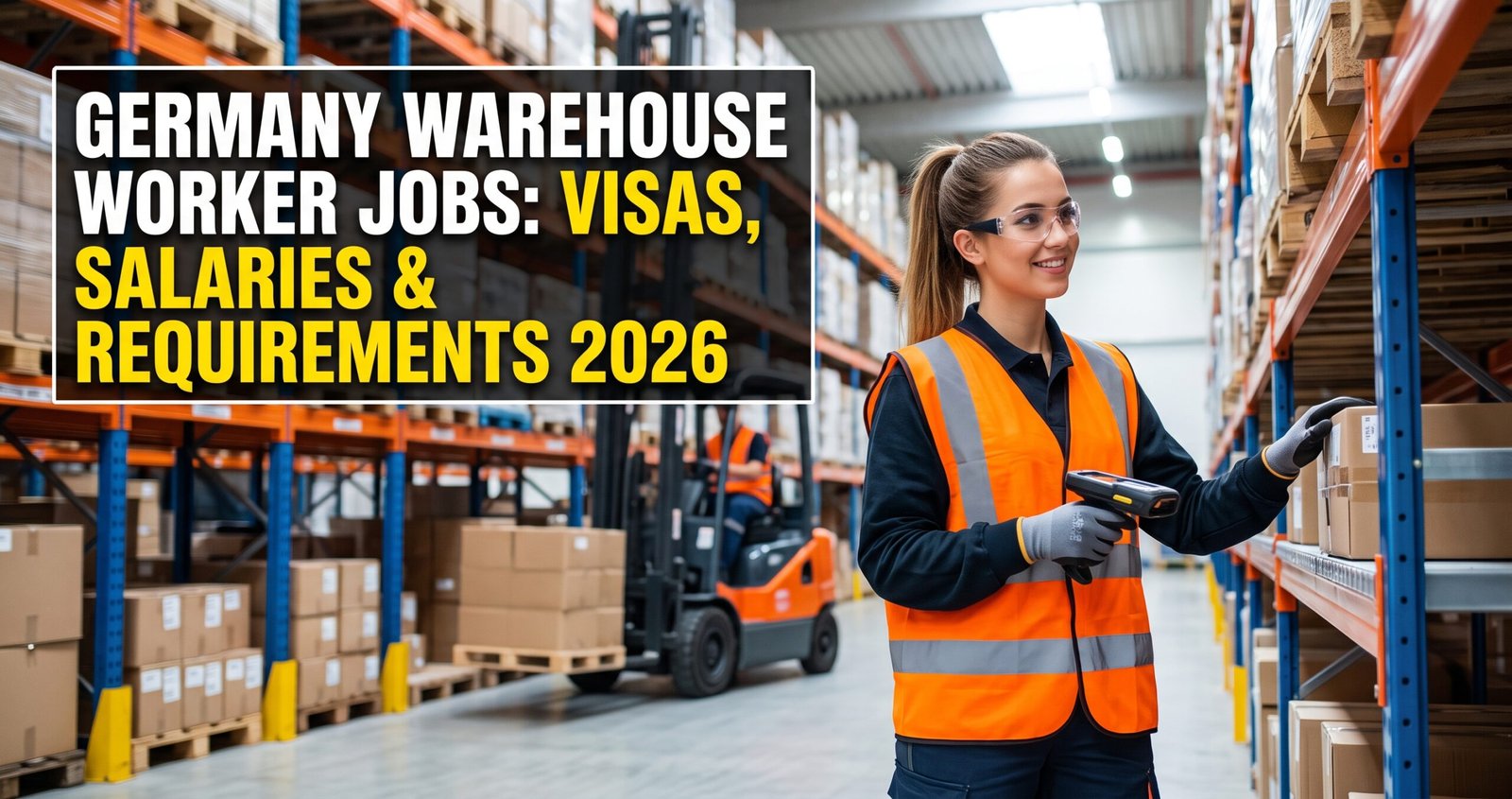
Germany Warehouse Worker Jobs: Visas, Salaries & Requirements 2026
Germany is known as the economic powerhouse of Europe, and in its epicenter lies a giant logistics and warehousing industry – which is both voluminous and extremely efficient. The need for warehouse staff in Germany is at an all-time high as a result of the upsurge in e-commerce, global and domestic supply chains. However, job deficits have arisen in the domestic market so that employers in Germany have had to increasingly seek foreign workers to fill these critical positions.
International job seekers tend to have a dream come true with a warehouse position in Germany as a means to build a stable life in Europe, which includes a good job, healthcare coverage and a sense of safety. But, opportunities to find work and gain legal right to work is blocked with misinformation, empty promises, complicated procedures and bureaucratic processes.
Overview of Germany’s Logistics and Warehouse Industry
Germany lies in the heart of Europe, and is its most important transcontinental region in the world. The country boasts large logistics enterprises, global shipping giants headquartered in the country, worldwide retail giants with their European headquarters in the country, and the biggest shipping ports such as Hamburg and Bremen. The supply chain is continuous and in Europe, the logistics industry employs millions and is deemed to be a critical infrastructure industry.
This industry has a number of specific advantages for foreign workers. Entry-level warehouse positions are also not all job positions that mandate a university education or flawless German).The first of note is that, unlike the other highly specialized tasks in a corporation, it is not the position for which a University education or perfect German is always required. The warehousing industry supplements many international workers with a strong base to stand on. It offers immediate work, regular income, opportunity to get in touch with the German system and enhance their language..
Types of Warehouse Jobs in Germany
The concept of “warehouse worker” (Lagerarbeiter or Lagermitarbeiter) encompassed many different types of jobs. Depending on your prior work history, background and physical fitness, you may end up with any of the following careers
Order Picker
This is the entry-level position in German logistics the most common. An order picker is tasked with picking up the required items from the shelves at the warehouse in accordance with customer orders and preparing the items for packing or shipping. In today’s modern warehouses, this function is commonly taken over by other state-of-the-art technologies like pick by light applications, voice picking headsets or handheld scanners. Prospective worker: Good Personal Stamina, Basic German or English language – Comprehending system commands, and High attention to detail.
Packer / Sorter
The order pickers collect these items in a box, pack them in the proper boxes and secure them with a shipping label and then wrap bubble wrap or padding around fragile items. Typically the sorters assist conveyor belts to move packages towards their shipping area more efficiently according to their destination. Key Requirements: Speed, efficiency and repetitive physical work.
Forklift Driver
The heavy lifting is done by forklift drivers. They load and unload goods transport trucks and move large pallets around the facility safely. Driving a forklift in Germany requires the owner to possess a particular license acknowledged by the state (Staplerschein). If your international license is already available you could attempt a conversion (this may be attempted, although many employers may sponsor this latter short course for trusted employees). Requirements: Forklift operator’s license (Staplerschein) and a high level of safety awareness and technical skills.
Warehouse Specialist
The skilled job which needs to be performed formally by means of vocational training (Ausbildung) in Germany. The role of warehouse specialist is far beyond the simple task of simply moving boxes around, as his job involves route planning, inventory control, quality assurance and administrative management of warehouses. Training Requirements: Vocational Training recognised, German (Proficiency Level B2 or above) and Organisation skills.
Salary Expectations: How Much Do Warehouse Workers Make in 2026?
The clearly-defined statutory minimum wage provision in Germany, which ensures a minimum standard of living, is one of the most appealing features of the job market in Germany. Logistics wages have steadily rose in tandem with inflation and to attract the much-needed talent..
The 2026 Minimum Wage Update
Starting 01.01.2026, the statutory minimum wage (Mindestlohn) in Germany will rise from €13.00 per hour gross to €13.90 per hour gross. By law, no employer can pay you less than this amount.
The minimum monthly gross wage works out to be about €2,409.33 for a basic 40 hours a week warehouse worker. To note is that a lot many logistics companies offer a slightly higher than this minimum, generally beginning to pay from €14.50 to €15.00 payroll per hour to their workers, particularly employees as per collective labor agreements .
Requirements & Qualifications: What Employers Actually Look For
German logistics corporations prioritize dependability, safety, and productivity. While they may not suppose a university degree, they preserve strict standards for their staff.
- Language Capabilities: While some decently international hubs (like convinced Amazon contentment centers) might allow you to work by means of only English, the vast common of German warehouses need at least an A2 to B1 level of German. You must be able to appreciate safety briefings, read basic scanner instructions, and communicate with change supervisors.
- Physical Fitness: Warehouse work is physically difficult. You will devote 8 hours a day on your feet, outdoor several kilometers, indirect, and lifting packages that can evaluate up to 15–20 kilograms. Good physical well-being is an absolute inflexible requirement.
- Clean Criminal Record: You will be treatment valuable produce. Almost all honest employers will demand a police clearance documentation (Polizeiliches Führungszeugnis) to confirm you have no history of stealing or fraud.
- Willingness to Work Shifts: Give is highly valued. Candidates who are keen to work rotating shifts—including early sunrises, late nights, and weekends—are greatly more likely to be appointed and retained.
Step-by-Step Guide: How to Find a Job and Secure Your Visa
To avoid being scammed and rejected for a job in Germany in a Warehouse when you are a non-EU citizen who wants to move to Germany- follow this step-by-step legal route.
Step 1: Prepare Your Documentation
Get Your Documents Before You Apply For One Job. Appropriate application of the CV in the format expected in Germany (Europass format is highly recommended) will be required. Please make sure that vocational certificates and degrees are issued by a certified translator and certified in the German Anabin database. Get your A1/B1 German and B2 English Certificate of your Language.
Step 2: Apply to Employers and Agencies
Begin your job search the web via platforms like StepStone, Indeed Germany or Make-it-in-Germany. Emphasize on the strength of temporary work agencies (Zeitarbeitsfirmen) like Randstad, Persona Service and Adecco. These agencies are more likely to help foreigners through the paperwork, and specialize in mass recruiting for logistics. Alternatively, you can also go to logistics companies such as DHL, DB Schenker, Kühne + Nagel and Amazon for your direct applications.
Step 3: Secure the Contract and Employer Declaration
After an employer agrees to employ you, they will need to issue two documents to you – a signed contract of employment (Arbeitsvertrag) and an Employer Declaration (Erklärung zum Beschäftigungsverhältnis). This statement is a template that outlines the exact salary, job description, and hours that a company receives for your employment. This document is essential to apply for a visa. As soon as you have your contract, declaration from the employer, passport, proof of health insurance and biometric photographs, make an appointment at the German Embassy / Consulate in your place of origin. Your application will be submitted to the Federal Employment Agency (Federal Labor Agency) in Germany by the consular officials for their approval. The time for this process is anywhere from 4-12 weeks.
Step 4: Apply for the Visa at the German Embassy
As soon as you have your contract, declaration from the employer, passport, proof of health insurance and biometric photographs, make an appointment at the German Embassy / Consulate in your place of origin. Your application will be submitted to the Federal Employment Agency (Federal Labor Agency) in Germany by the consular officials for their approval. The time for this process is anywhere from 4-12 weeks.
Step 5: Relocate and Register
Once your permit is accepted, travel to Germany. Within your original two weeks, you must register your inhabited address (Anmeldung) at the local citizens’ office (Bürgeramt). Without this registering, you cannot get your tax ID, and wanting a tax ID, you cannot become paid properly.
Top Employers and Recruitment Agencies in Germany
A critical part of the game is knowing where to find them. The largest employers of warehouse workers in Germany are the following:
- Deutsche Post DHL Group: Germany’s national carrier, DHL is an international logistics company that is constantly looking to recruit. Most famous for their compliance with labor laws and strong union representation.
- Amazon Germany: Amazon has a number of gigantic fulfillment centers in Germany (including Bad Hersfeld, Leipzig and Pforzheim). They have extensive experience with bringing international staff on board, and have processes in place to simplify the onboarding procedure.
- DB Schenker & Kühne + Nagel: This is the classic type of large volume freight forwarding companies with huge warehouses that deal with heavy goods, or international freight.
- Zeitarbeitsfirmen (Temporary Work Agencies): Companies such as Randstad, Adecco, Manpower and Persona service serve as intermediaries between employees and employers. You’ve a contract with the agency and are sent to work at a multitude of warehouses. The first way to gain access are often known at foreigners as the easiest method.
Common Pitfalls and Job Scams to Avoid
Everyone wants to work in Europe, which is why there are many people with a bad intention in the logistics sector. If you are an employee, you have to be protected by understanding German law – you’re looking to get a job, after all.
- 1. The “Guaranteed Visa” Scam: A common scam is the “Guaranteed Visa” where no agency, lawyer or recruiter can guarantee a work visa for the Germany for anybody. It is entirely up to the German Embassy and the Federal Employment Agency (BFA). Any recruiter who claims to guarantee a 100% visa is lying.
- 2. Charging Candidates for Job Placements: In Germany, respectable job placement firms will not place candidates without their permission, but will do so only at their employer’s direction. Any agency that requires payment of an “administrative fee,” “doc processing fee” or “interview fee” in advance, before conferring warehouse employment, is almost certainly a scam. Walk away immediately.
- 3. Fake Contracts for Visa Applications: Don’t purchase fake employment contract to make successful the Embassy interview. The German authorities liaise directly with the companies when they complete the Employer Declaration. Provide falsified paperwork and the visa will be refused and they will be barred from entering the Schengen Area from then on.
- 4. Misunderstanding Gross vs. Net Pay: One common misconception about gross and net pay is that scammers might post a job that offers €3,000/month—without indicating that this is gross pay and unconfirmed overtime is included. Be sure to ask the base hours rate and determine your net pay to see if you can afford living in Germany.
Also Read : canada-work-visa-guide-2026/
FAQs
-
Can I move to Germany as a warehouse worker without speaking German?
While it is technically likely (especially with international businesses like Amazon), it is incredibly trying to secure a visa without verbal skills. The Chancenkarte needs at least A1 German or B2 English. Still, navigating daily life, housing, and administration in Germany requires at minimum basic German.
-
Does a warehouse job qualify for the EU Blue Card?
No. The EU Blue Card is severely reserved for highly competent professionals (like IT specialists, contrives, and doctors) who have a university gradation and a high salary beginning. Warehouse roles fall below standard employment passes or the Opportunity Card pathway.
-
Is it easy to bring my family with me?
Family recombination for non-EU citizens depend on on your ability to confirm sufficient living space and fiscal means. Because warehouse jobs offer lower-tier salaries, verifying you earn enough to support a non-working significant other and children can be decidedly challenging in costly German cities.
-
Are there age limits for warehouse jobs in Germany?
Legally, there is no severe upper age boundary for employment, but warehouse work is physically difficult. Employers usually prefer able-bodied personalities. However, for the Chancenkarte, existence under 35 or between 35 and 40 yields crucial points, connotation older applicants resolve find the visa development more challenging.
Final Thought
The path to a warehouse worker position in Germany for 2026 is legitimate, well-established and structured. The minimum wage hikes to €13.90 per hour and the enforcement of tight regulations and labor laws that guarantee your rights make the industry of logistics a safe and secure arena for providing for yourself.
As a non-EU citizen, it is necessary to be patient, honest and meticulous to navigate the visa system, however. With the Chancenkarte new doors have opened; provided that the applicant has the proper education and language skills.
The key to success in this voyage is to follow the detective work steps – get certified translations, learn the language, apply to reputable agencies, and most importantly, stay clear of visa scams that promise instant visas or guarantee your visa success. Knowing your rights, you can truly embark on a promising new phase in the prosperous world of logistics in Germany with confidence.