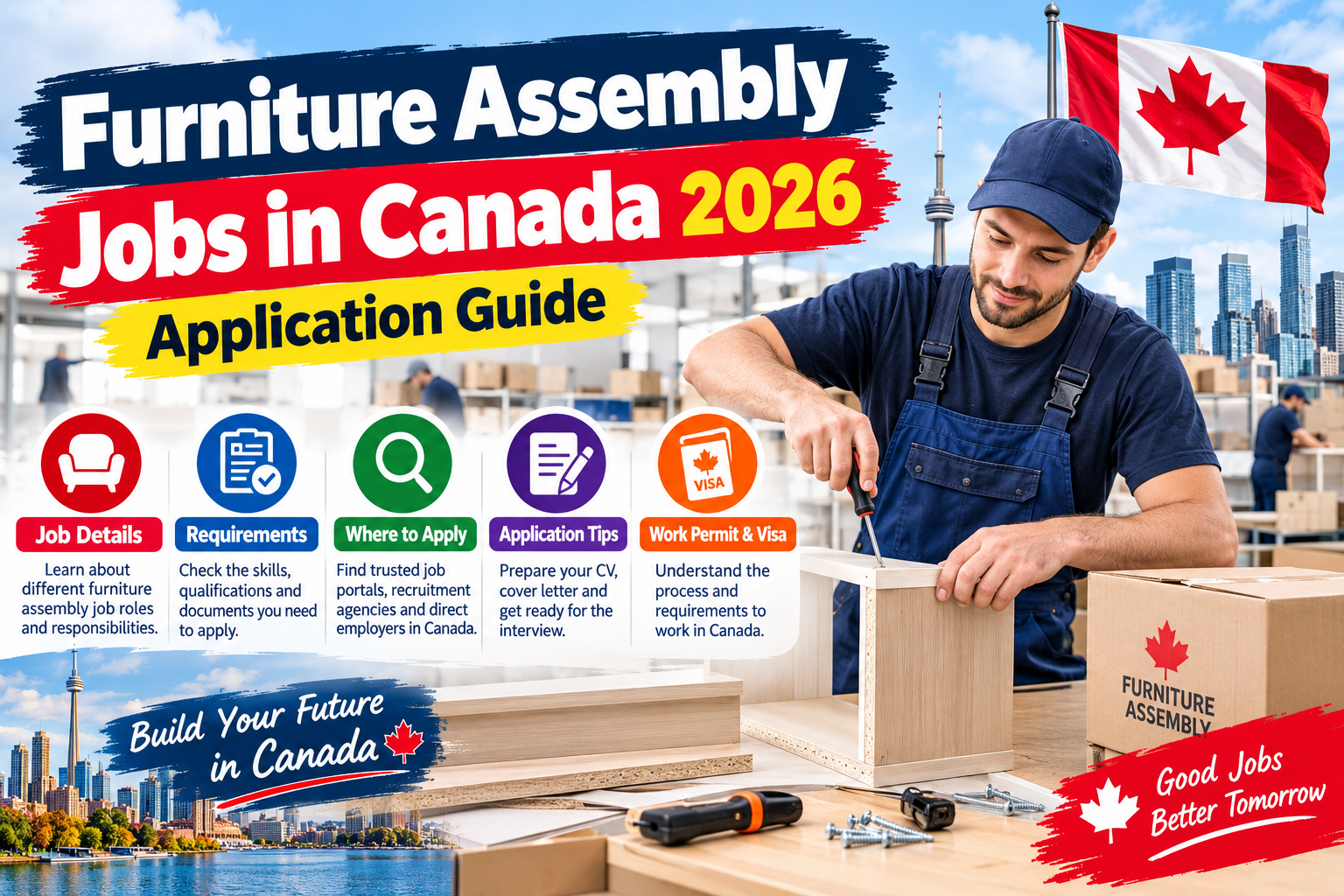
Furniture assembly is a major sector within Canada’s manufacturing and retail industries. Many businesses manufacture, sell, and distribute furniture for residential homes, corporate offices, retail spaces, and public buildings. These companies rely on skilled assemblers to build products and prepare finished items for customers.
Furniture assembly workers build a wide variety of items, including tables, chairs, bed frames, cabinets, and office workstations. Some work in large-scale manufacturing plants or distribution warehouses, while others perform field installations directly at a customer’s home or office.
If you are seeking employment in 2026, furniture assembly jobs in Canada offer excellent opportunities. While many entry-level roles provide on-the-job training, employers frequently seek candidates with practical tool experience or prior background in woodworking and manufacturing.
However, securing a job depends on employer requirements, your practical skills, and your legal right to work in Canada. Foreign applicants must also verify whether an employer is eligible and willing to support a Canadian work permit application.
This guide provides a comprehensive overview of furniture assembly jobs in Canada for 2026, covering available job roles, primary duties, entry requirements, work permit processes, general working conditions, and step-by-step application advice.
What Are Furniture Assembly Jobs?
Furniture assembly involves joining individual components, hardware, and structural pieces to create finished, fully functional furniture.
Assemblers use a variety of hand tools, power tools, and fasteners—such as screws, bolts, hinges, and dowels—to put items together.
Because much of modern furniture is manufactured in flat-pack or modular formats, assembly workers must carefully read technical blueprints, schematics, and step-by-step assembly guides to construct items in the correct order.
In a large factory setting, a worker might focus on a single specialized step along an assembly line. In a smaller custom workshop, an assembler may build a complex piece of furniture from start to finish.
Workers are responsible for conducting quality checks to ensure that every finished product is sturdy, properly aligned, and safe for consumer use.
Types of Furniture Assembly Jobs in Canada
Furniture manufacturing and distribution companies rely on several distinct assembly roles to meet market demand.
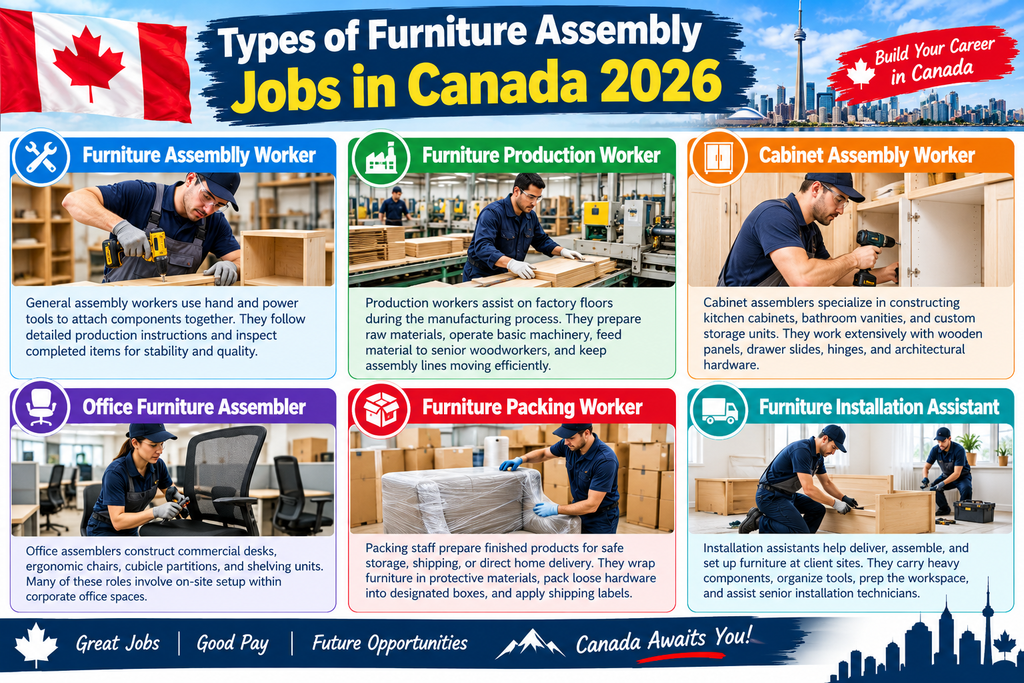
Furniture Assembly Worker
General assembly workers use hand and power tools to attach components together. They follow detailed production instructions and inspect completed items for stability and quality.
Furniture Production Worker
Production workers assist on factory floors during the manufacturing process. They prepare raw materials, operate basic machinery, feed material to senior woodworkers, and keep assembly lines moving efficiently.
Cabinet Assembly Worker
Cabinet assemblers specialize in constructing kitchen cabinets, bathroom vanities, and custom storage units. They work extensively with wooden panels, drawer slides, hinges, and architectural hardware.
Office Furniture Assembler
Office assemblers construct commercial desks, ergonomic chairs, cubicle partitions, and shelving units. Many of these roles involve on-site setup within corporate office spaces.
Furniture Packing Worker
Packing staff prepare finished products for safe storage, shipping, or direct home delivery. They wrap furniture in protective materials, pack loose hardware into designated boxes, and apply shipping labels.
Furniture Installation Assistant
Installation assistants help deliver, assemble, and set up furniture at client sites. They carry heavy components, organize tools, prep the workspace, and assist senior installation technicians.
Main Duties of Furniture Assembly Workers
Daily responsibilities vary depending on the employer, work environment, and product line. While some workers perform high-volume assembly line work, others divide their time between assembly, quality control, packaging, and material handling.
Common daily duties include:
- Reading and interpreting assembly instructions, blueprints, and diagrams.
- Joining wood, metal, composite, or plastic furniture components.
- Operating hand tools, cordless drills, screwdrivers, pneumatic nail guns, and clamps.
- Installing hardware, including hinges, handles, drawer slides, and brackets.
- Inspecting finished products for structural flaws, scratches, or alignment issues.
- Preparing completed furniture for protective wrapping and packaging.
- Transporting raw materials and finished goods around the shop floor.
- Maintaining clean, hazard-free workstations and inspecting tools regularly.
- Following all occupational health and safety guidelines.
Because safety and quality are paramount, workers must exercise precision when operating tools and ensure that all joints and fasteners are securely anchored.
Requirements for Furniture Assembly Jobs in Canada
Job requirements depend on the specific role and the complexity of the furniture being manufactured.
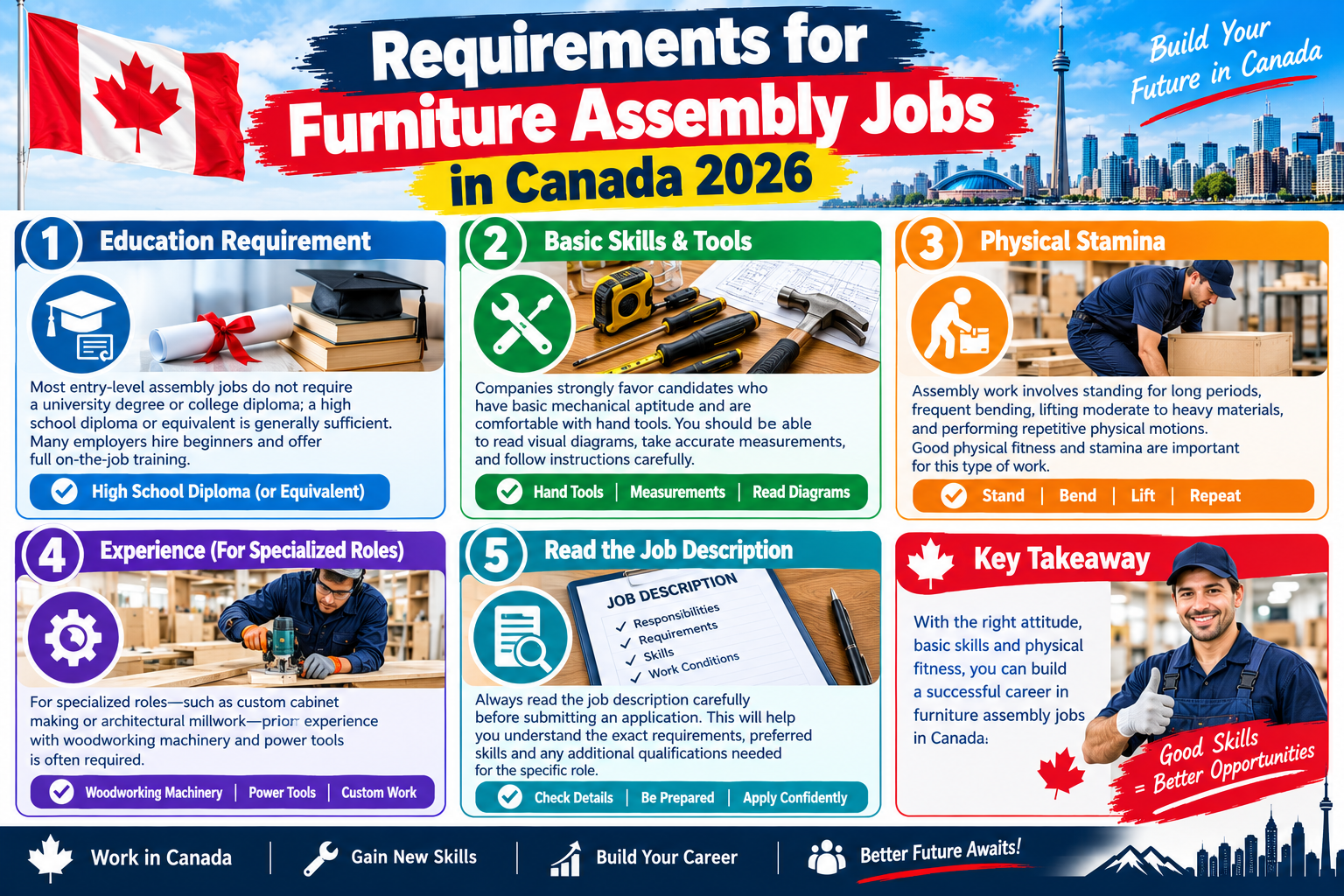
Most entry-level assembly jobs do not require a university degree or college diploma; a high school diploma or equivalent is generally sufficient. Many employers hire beginners and offer full on-the-job training.
However, companies strongly favor candidates who demonstrate basic mechanical aptitude and comfort with hand tools. Candidates should be able to read visual diagrams, take accurate measurements, and follow instructions carefully.
Physical stamina is essential. Assembly work involves standing for long periods, frequent bending, lifting moderate to heavy materials, and performing repetitive physical motions.
For specialized roles—such as custom cabinet making or architectural millwork—prior experience with woodworking machinery and power tools is often required. Always read the job description carefully before submitting an application.
Is Previous Experience Necessary?
Prior experience is not strictly required for entry-level furniture assembly positions. Many commercial manufacturers train new hires on simple assembly techniques, tool usage, and packaging protocols.
However, having prior experience can significantly improve your job prospects. Backgrounds in carpentry, cabinet making, construction, millwork, or factory production provide transferable skills that employers value.
For specialized assembly roles or complex client installations, employers typically prefer workers with proven hands-on experience. Some companies may conduct a practical skills test during the interview process to evaluate your tool handling and blueprint reading ability.
Language Requirements for Furniture Assembly Jobs
English is the primary language of operation in most Canadian provinces and territories.
In Quebec and certain regions across Eastern Canada, French is the primary language or a major asset in the workplace.
The level of language proficiency required depends on your specific position. Furniture assemblers must be able to understand safety warnings, follow verbal instructions from supervisors, and read assembly manuals.
A basic to intermediate working knowledge of English or French is usually sufficient for factory and warehouse environments. However, roles that require direct customer interaction—such as residential installation assistants—demand stronger communication skills.
Can Foreign Workers Apply for Furniture Assembly Jobs in Canada?
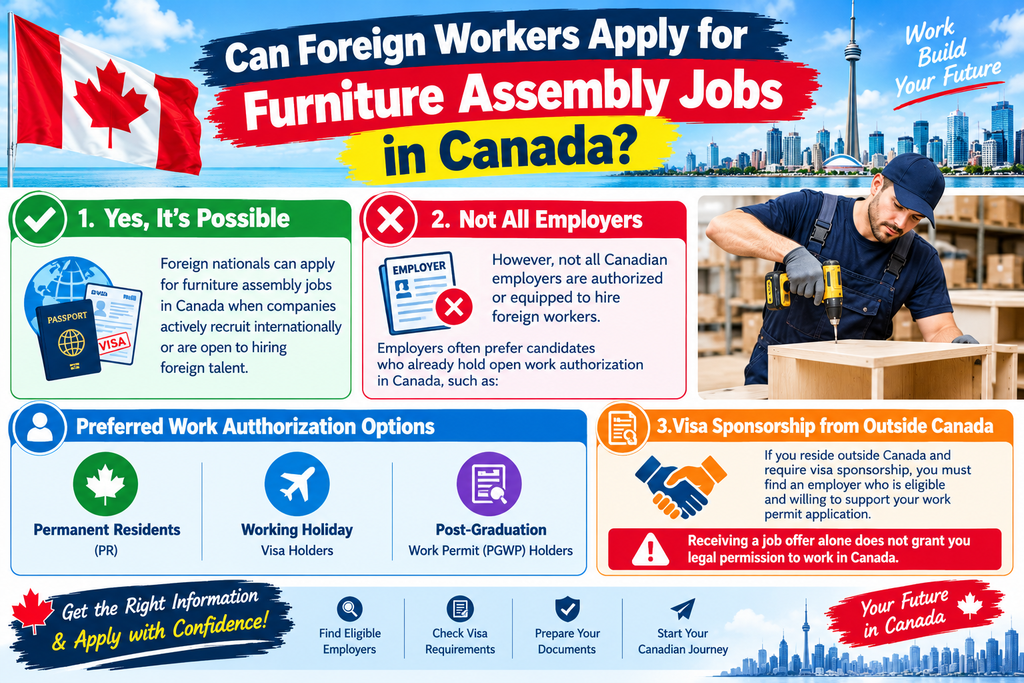
Yes, foreign nationals can apply for furniture assembly jobs in Canada when companies actively recruit internationally or are open to hiring foreign talent.
However, not all Canadian employers are authorized or equipped to hire foreign workers. Employers often prefer candidates who already hold open work authorization in Canada, such as Permanent Residents, Working Holiday visa holders, or Post-Graduation Work Permit (PGWP) holders.
If you reside outside Canada and require visa sponsorship, you must find an employer who is eligible and willing to support your work permit application. Receiving a job offer alone does not grant you legal permission to work in Canada.
Work Permit Requirements for Canada
Foreign nationals must obtain valid legal authorization before commencing work in Canada.
Most foreign applicants applying from outside Canada require an employer-specific work permit (closed work permit). To support this application, the Canadian employer typically must obtain a positive Labour Market Impact Assessment (LMIA) from Employment and Social Development Canada (ESDC).
An LMIA is a formal process verifying that a Canadian employer tried to hire a Canadian citizen or Permanent Resident before offering the position to a foreign worker. Some specific job categories or international agreements may be exempt from the LMIA requirement.
Applicants must submit various supporting documents, including a valid passport, a signed employment contract, an official job offer letter, proof of relevant work experience, and any required LMIA documentation provided by the employer.
Never start working in Canada until your work permit has been officially approved by Immigration, Refugees and Citizenship Canada (IRCC).
How to Apply for Furniture Assembly Jobs in Canada
Applying for furniture assembly roles requires a well-structured resume and a strategic job search.
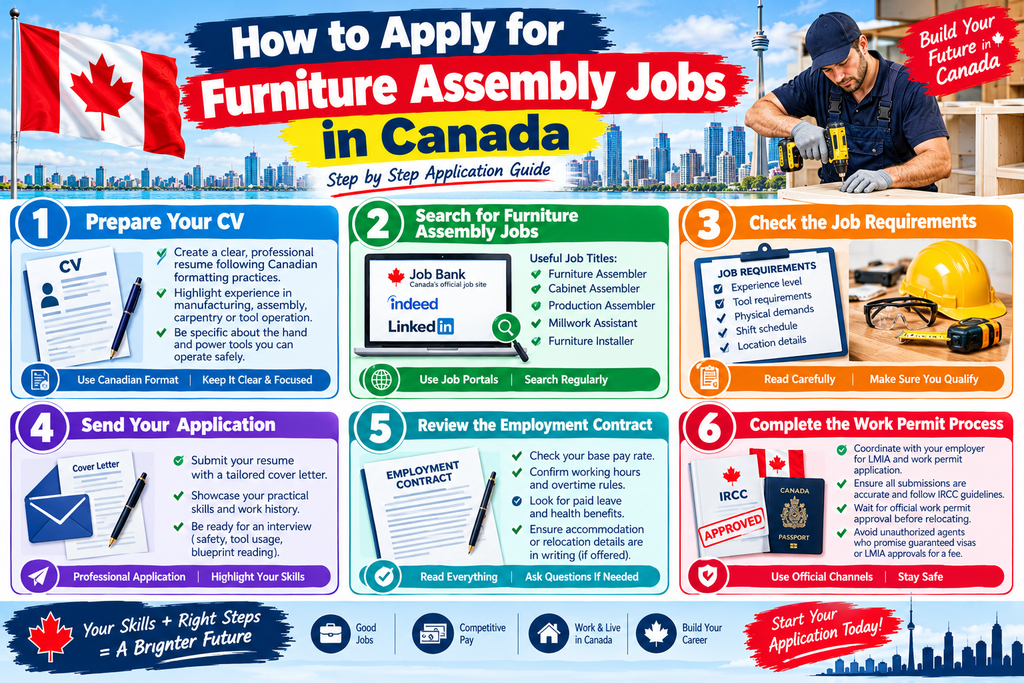
Step 1: Prepare Your CV
Create a clear, professional resume following standard Canadian formatting practices. Highlight any experience in manufacturing, assembly, carpentry, or tool operation. Be specific about the exact hand and power tools you know how to operate safely.
Step 2: Search for Furniture Assembly Jobs
Search online job portals—such as Canada’s official Job Bank, Indeed, and LinkedIn—for open positions. Useful job titles include Furniture Assembler, Cabinet Assembler, Production Assembler, Millwork Assistant, and Furniture Installer.
Step 3: Check the Job Requirements
Review job postings carefully to verify minimum experience levels, tool requirements, physical demands, shift schedules, and location details.
Step 4: Send Your Application
Submit your resume along with a tailored cover letter explaining your practical skills and work history. If invited to an interview, be prepared to answer questions about workplace safety, tool usage, and blueprint reading.
Step 5: Review the Employment Contract
If you receive a job offer, review the employment agreement thoroughly before signing. Ensure you fully understand your base pay rate, working hours, overtime rules, paid leave allowances, and workplace health benefits. If the employer offers accommodation or relocation assistance, ensure all details are documented in writing.
Step 6: Complete the Work Permit Process
If you require immigration sponsorship, coordinate with your employer to complete the LMIA and work permit application steps. Ensure all submissions are accurate, follow official IRCC guidelines, and wait for official work permit approval before relocating to Canada. Avoid unauthorized agents who promise guaranteed visas or LMIA approvals for a fee.
Working Conditions for Furniture Assembly Workers
Furniture assemblers perform their work indoors within manufacturing plants, woodworking shops, warehouses, or client premises.
Workstations are typically equipped with workbench setups, overhead lighting, pneumatic lines, and ergonomic tool racks. Depending on the product line, workers spend most of their shift standing, reaching, bending, and lifting wooden boards, metal frames, and heavy furniture components.
Factory settings operate on fixed schedules or rotating shift patterns, including morning, afternoon, and night shifts. Installation workers travel between client sites, which may involve variable working hours and time spent in work vans.
Physical effort is a routine part of the job, particularly when handling solid wood or commercial-grade office furniture. Following proper lifting techniques and ergonomic principles helps reduce physical fatigue and injury.
Important Safety Rules for Furniture Assembly Workers
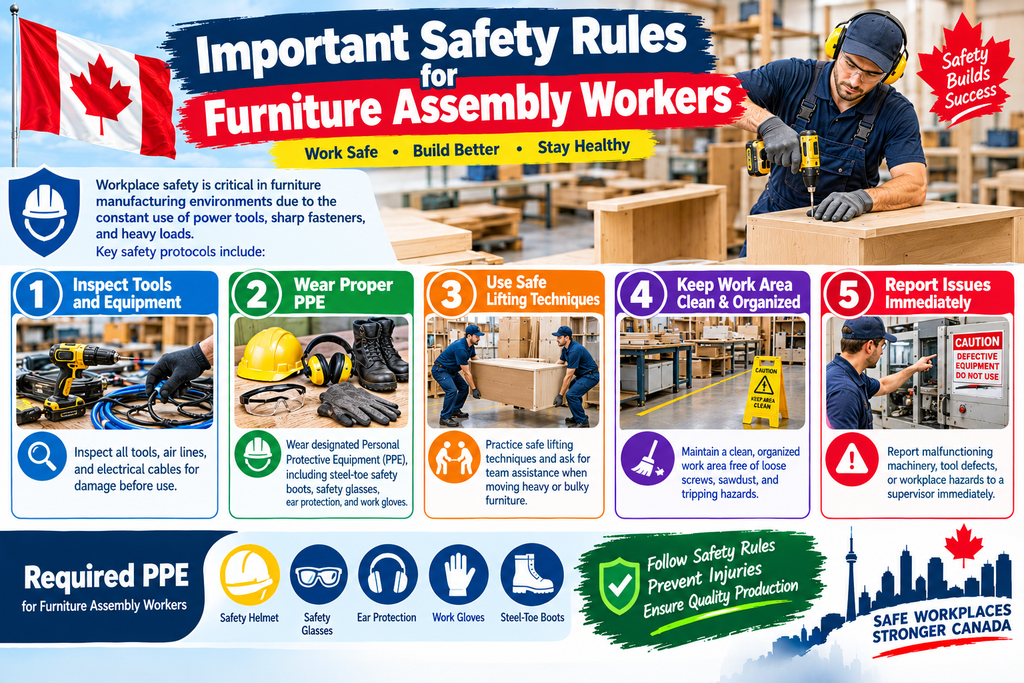
Workplace safety is critical in furniture manufacturing environments due to the constant use of power tools, sharp fasteners, and heavy loads.
Key safety protocols include:
- Inspecting all tools, air lines, and electrical cables for damage before use.
- Wearing designated Personal Protective Equipment (PPE), including steel-toe safety boots, safety glasses, ear protection, and work gloves.
- Practicing safe lifting techniques and asking for team assistance when moving heavy or bulky furniture.
- Maintaining a clean, organized work area free of loose screws, sawdust, and tripping hazards.
- Reporting malfunctioning machinery, tool defects, or workplace hazards to a supervisor immediately.
Adhering strictly to health and safety regulations prevents workplace injuries and ensures high-quality production standards.
Furniture Assembly Job Roles and Responsibilities
| Job Role | Main Work |
| Furniture Assembly Worker | Assemble furniture components using hand tools and hardware |
| Furniture Production Worker | Support factory manufacturing lines and prepare materials |
| Cabinet Assembly Worker | Build kitchen, bathroom, and storage cabinetry |
| Office Furniture Assembler | Construct desks, chairs, and modular office partitions |
| Furniture Packing Worker | Inspect, wrap, and box completed furniture for shipment |
| Installation Assistant | Assist with the delivery and on-site assembly of client furniture |
Note: Specific duties vary depending on company size and product specialization.
Frequently Asked Questions
Can foreigners get furniture assembly jobs in Canada in 2026?
Yes, foreign workers can apply for furniture assembly jobs in Canada. However, candidates who require a work permit must secure a valid job offer from an eligible employer and satisfy all IRCC immigration requirements.
Do furniture assembly jobs require a degree?
No formal post-secondary degree is required for standard assembly roles. Employers generally look for a high school diploma, mechanical aptitude, and practical tool experience.
Can I apply without experience?
Yes, many entry-level assembly positions do not require prior experience, as employers provide on-the-job training. However, having basic hands-on experience with tools is a strong advantage.
Is furniture assembly physically difficult?
It can be physically demanding. Workers stand for extended periods, perform repetitive manual tasks, and frequently lift heavy panels or finished furniture items.
Is English required for furniture assembly jobs?
A functional working knowledge of English (or French in Quebec) is generally required to understand safety instructions, read assembly diagrams, and communicate effectively with team members.
Do furniture assembly jobs offer LMIA support?
Some Canadian employers apply for an LMIA to hire foreign assembly workers when local labor shortages exist. However, LMIA support is not guaranteed for every job posting.
Do employers provide accommodation?
In general, standard industrial employers in Canada do not provide housing. Workers are expected to arrange their own accommodations unless explicitly stated otherwise in an official employment contract.
Conclusion
Furniture assembly jobs in Canada in 2026 offer rewarding, practical employment opportunities for individuals who enjoy hands-on work, tool operation, and manufacturing.
Positions range from entry-level production line work and packaging to specialized cabinet making and on-site commercial installation. While entry-level roles welcome beginners, practical mechanical skills and attention to detail will significantly improve your employment prospects.
If you are an international applicant, take time to understand Canada’s work permit regulations, verify an employer’s eligibility to hire foreign workers, and prepare a clear, tool-focused CV. Careful planning and thorough preparation will help you navigate the application process successfully.