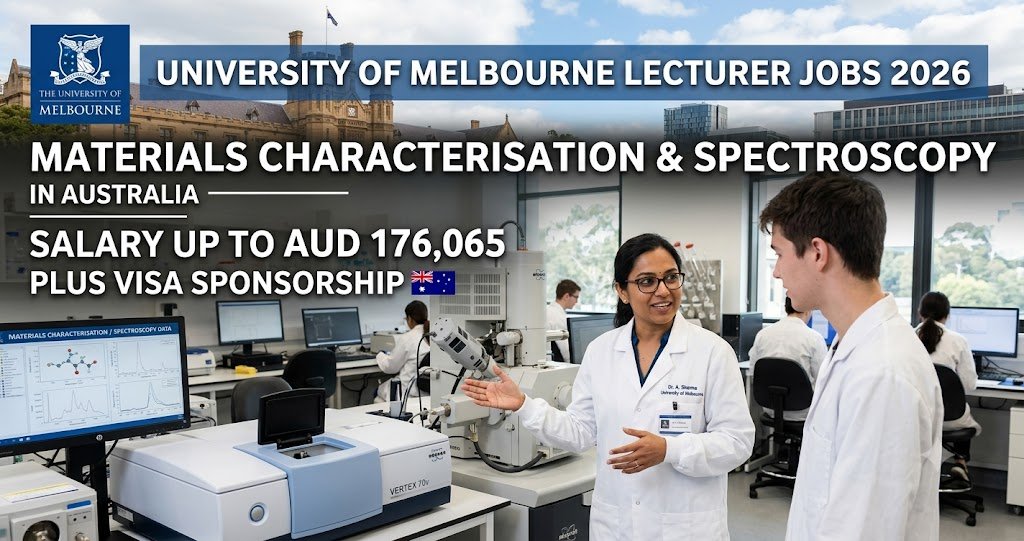
Introduction to University of Melbourne Lecturer Jobs 2026
If you are searching for one of the most prestigious careers in the university of Australia, the University of Melbourne Lecturer in Materials Characterisation & Spectroscopy Jobs 2026 have presents an outstanding opportunity for a researchers, educators, and scientists who wish to build a long-term academic career at one of the leading universities in the world. This full-time continuing academic position have offers an attractive annual salary which is ranging from a AUD 124,656 to AUD 176,065, plus an exceptional 17% superannuation package and a comprehensive range of the employee benefits. More importantly, the university have welcomes an international applicants by offering a visa sponsorship, with making this opportunity as highly attractive for a qualified professionals from around the world.
The position is based within the renowned School of Chemistry under the Faculty of Science, where a successful candidates will contribute to the internationally recognized research while inspiring the next generation of a scientists through an undergraduate and postgraduate teaching. The successful applicant will have the opportunity to establish an independent program of research as focused on the Materials Characterisation and Spectroscopy, collaborate with a multidisciplinary researchers, supervise the Honours, Master’s, and PhD students, publish in a leading scientific journals, and compete for a national and international research funding. With an access to the advanced optical instrumentation, world-class laboratories, and a collaborative academic environment, this role have offers far more than a traditional teaching responsibilities. It have provides the foundation for building an internationally respected research career while enjoying an excellent work-life balance, opportunities of a professional development, and long-term stability of employment. This comprehensive guide will explains everything as prospective applicants need to know, with including a criteria of eligibility, responsibilities, salary, benefits, visa sponsorship, process of application, required qualifications, and practical tips to improve their chances of securing this highly competitive academic position.
University of Melbourne Lecturer Jobs 2026 – Position Overview
The University of Melbourne Lecturer in Materials Characterisation & Spectroscopy Jobs 2026 is a continuing full-time academic opportunity which is designed for a highly qualified researchers who are passionate about both the scientific discovery and university teaching. Unlike a short-term research contracts or postdoctoral appointments, this position will provides a long-term stability of career while allowing the successful candidate to establish an independent profile of research in one of most rapidly advancing fields in the chemistry. The appointment level will depend on the qualifications of candidate, teaching achievements, publication record, research funding success, and overall academic experience. Applicants may be appointed at a Level B with a salary in between a AUD 124,656 and AUD 148,023 per year, or Level C with a salary which is ranging from a AUD 152,695 to AUD 176,065 per year, with an additional 17% employer superannuation contribution. This generous compensation package have reflects the commitment of university to attracting a world-class researchers and educators from the Australia and overseas.
The position is located in a Melbourne, Victoria, which is one of leading educational, scientific, and innovation hubs in the Australia. The successful applicant will become a part of the Faculty of Science’s internationally respected School of Chemistry, which have maintains a strong reputation for an excellence in the teaching, cutting-edge research, and global collaboration. Beyond delivering a lectures and laboratory classes, the selected lecturer will design an innovative projects of research, supervise the postgraduate students, develop a partnerships with the industry and organizations of research, and actively contribute to the strategic growth of school. Because the university have encourages an interdisciplinary collaboration, researchers have frequently work alongside an experts in the physics, engineering, biology, materials science, nanotechnology, and environmental science. The role have therefore provides an ideal platform for the academics who wish to expand both their influence of research and portfolio of teaching while contributing to the scientific advancements that address a real-world challenges.
About the University of Melbourne
Founded in the 1853, the University of Melbourne is consistently ranked in among the leading universities of Australia and enjoys a strong international reputation for an excellence in the research, innovation, and higher education. Its Faculty of Science has produced an influential discoveries in across a numerous scientific disciplines and continues to attract an outstanding researchers from around the world. The School of Chemistry, which is established as shortly after the founding of university, has developed into one of largest chemistry schools in the Australia, with educating a thousands of the undergraduate students while supporting a vibrant community of the Honours, Master’s, and PhD researchers. The school’s research spans analytical chemistry, materials science, spectroscopy, chemical biology, sustainable chemistry, energy materials, computational chemistry, and molecular design, with creating an intellectually stimulating environment where an interdisciplinary collaboration is encouraged and supported.
Working at the University of Melbourne have means becoming the part of a research-intensive institution that have invests as heavily in an advanced infrastructure of laboratory, high-performance scientific equipment, and international partnerships. Researchers have benefit from an access to state-of-the-art spectroscopy facilities, optical instrumentation, microscopy laboratories, computational resources, and collaborative research centres that have enable an ambitious scientific projects. Beyond an excellence in research, the university have strongly values an inclusive education, student success, diversity, integrity, and professional development. Academic staff are encouraged to participate in a programs of leadership, initiatives of a industry engagement, international collaborations, and activities of outreach that have strengthen both their careers and the global impact of university. These combined opportunities have make the University of Melbourne as one of the most attractive employers for an academics seeking a long-term professional growth within a supportive and globally respected institution.
Lecturer in Materials Characterisation & Spectroscopy Position
The primary objective of this position is to establish and lead an internationally competitive program of research in the Materials Characterisation and Spectroscopy while contributing to an outstanding teaching in university in across the undergraduate and courses of a postgraduate chemistry. Materials characterisation have plays a critical role in understanding the physical, structural, optical, and chemical properties of an advanced materials that are used in electronics, renewable energy, medicine, nanotechnology, and environmental applications. Spectroscopy techniques, with including an ultrafast laser spectroscopy, Raman microscopy, and confocal fluorescence microscopy, will provide the researchers with a powerful analytical tools for investigating the molecular behaviour and material performance at a microscopic levels. The successful lecturer will therefore contribute not only to an academic teaching but also to a research which is capable of driving a scientific innovation with the significant industrial and societal benefits.
In an addition to conducting the independent research, the successful applicant will supervise a research students, mentor early-career researchers, coordinate the activities in laboratory, publish findings in a high-impact international journals, and prepare a competitive grant proposals to secure an external funding. Building collaborations with a national and institutions of an international research, government agencies, and industry partners will also form an important component of the role. Because modern scientific research have increasingly relies on an interdisciplinary collaboration, the lecturer will have an opportunities to work in across the chemistry, engineering, biology, materials science, and physics, with expanding both a research impact and potential of funding. This combination of a teaching, leadership, mentorship, research excellence, and innovation have makes the role as significantly broader than a traditional position as a lecturer in university and offers an exceptional career pathway for the ambitious scientists who are aiming to become internationally recognised academic leaders.
About the University of Melbourne and the School of Chemistry
The University of Melbourne is one of most respected institutions in the Australia, with a long-standing reputation for an academic excellence, research innovation, and global impact. Its School of Chemistry is especially well known for combining a strong traditions of teaching with a forward-looking culture of research that have supports a discovery in across the materials science, physical chemistry, analytical chemistry, and interdisciplinary innovation. For a candidate who is looking for a serious academic role on long-term, this is not just another position in university; it is an opportunity to join a highly established environment where a research is taken as seriously, teaching is valued, and professional growth is actively supported. The School has a broad academic community, strong institutional resources, and a track record of attracting an external funding, which have makes it a highly competitive and rewarding place to build a career.
What have makes this role as even more attractive is the way the School of Chemistry that connects a traditional scientific excellence with the modern priorities of research. Materials characterisation and spectroscopy have sit at the heart of many important scientific and industrial developments, with including an advanced materials, energy systems, environmental analysis, biomedical applications, and nanotechnology. A lecturer in this area is expected to contribute not only to a teaching, but also to the generation of a new knowledge, publication in the respected journals, and the training of a future researchers. In a practical terms, this means the successful candidate will be working in a setting where their ideas can grow into a funded projects, their research can shape the scientific conversations, and their teaching can influence the next generation of a chemists and scientists. For an applicants who want an academic meaning, career security, and international recognition, this role have stands out as clearly.
Job Overview: Lecturer in Materials Characterisation and Spectroscopy
This position is a full-time, continuing academic appointment within the Faculty of Science, specifically in the School of Chemistry. The advertised role is designed for a scholar who can balance an independent research, teaching, supervision, and academic service while also contributing to the long-term strategic goals of the department. It is a high-level academic job that have expects both a scientific depth and strong skills of communication. The salary level have depends on a qualifications and experience, with a Level B which is ranging from a AUD 124,656 to AUD 148,023 per year plus 17% superannuation, and Level C which is ranging from AUD 152,695 to AUD 176,065 per year plus 17% superannuation. That range of salary have reflects the seriousness of the appointment and the expectation of university that the candidate will bring a strong academic profile to the role.
The role have focuses on a materials characterisation and spectroscopy, which are broad and powerful areas of research with an applications in across the chemistry and related scientific fields. The university is looking for someone who can establish or strengthen an independent program of research, use an advanced optical and spectroscopic facilities as effectively, and connect the agenda of research with a teaching and collaboration. This is the kind of a position that have suits a candidate who wants to move as beyond a routine academic duties and into a role with the real visibility, potential of leadership, and scientific influence. In an addition, the position is eligible for a visa sponsorship, which have makes it as accessible to a qualified international candidates who meet the academic and professional requirements. For a researchers who are outside Australia, that is a major advantage and a strong reason to consider for applying.
Key Responsibilities and What the University Expects
The lecturer will be responsible for building and leading an independent program of research in the materials characterisation and spectroscopy. This have means identifying an important questions of research, designing an experiments, using the advanced instrumentation, collecting and interpreting a data, and publishing a results in the high-quality international journals. The role is not limited to performing an experiments; as it have also requires a clear vision of research and the ability to attract a funding through the competitive grant applications. In a environment of university like as Melbourne, this output of research have matters because it helps to strengthen the reputation of department, supports a collaboration with the other academics, and contributes to a broader scientific and societal progress. Applicants should therefore be prepared to show a serious record of the achievement of research and the ability to generate a future research impact.
Teaching and supervision form another major part of the role. The successful candidate will contribute to an undergraduate and graduate teaching, will help to coordinate a demonstrators of laboratory, and supervise the students at Honours, MSc, and PhD level. This is important because the university have expects a lecturers to be an active educators, not just a researchers. Good teaching in the chemistry have requires a clarity, patience, technical knowledge, and the ability to connect theory with the practical laboratory work. A lecturer in this position will likely be involved in guiding a students through the complex scientific ideas, with helping them develop an experimental skills, and encouraging them to become the independent thinkers. The role have also includes an academic leadership, participation in a school and committees of faculty, engagement of community, and support for a positive and inclusive culture. In other words, this is a job for someone who can contribute as meaningfully to both the scientific and human side of a university life.
Required Qualifications and Professional Background
The most essential qualification for this position is a PhD in Chemistry. This have indicates that the university is looking for a highly trained academic with a deep understanding of the chemical science and related methods of research. However, the PhD alone is not enough. The candidate should also have a hands-on expertise in one or more advanced spectroscopic or imaging methods, especially an ultrafast laser spectroscopy, confocal fluorescence microscopy, or Raman microscopy. These techniques are valuable because they allow a detailed study of the materials at a highly precise level, and they have align closely with the direction of research of the School of Chemistry. A strong candidate would be able to explain not only how these techniques will work, but also how they can be used to solve a scientific problems and create a high-impact outputs of research.
The university have also expects an evidence of a strong record of publication and real influence of research. That have means a peer-reviewed papers, a history of working on a significant projects, and a demonstrated ability to contribute to an academic knowledge in a meaningful ways. Experience in preparing or contributing to the competitive grant applications is highly desirable because the role is designed for someone who can help to expand the external funding profile of department. In an addition, the university have values a collaboration, so the ability to work with a researchers in across the disciplines, institutions, and industry partners will strengthen an application. Teaching experience is also important, especially if it includes chemistry instruction at university level and supervision of a postgraduate students. Finally, the candidate should show a strong skills of communication, collegiality, and a commitment to diversity, inclusion, and research integrity, because these qualities are central to an academic life at Melbourne.
Salary, Superannuation, and Employee Benefits
One of the strongest features of this role is its competitive package of compensation. The advertised salary have sits at a highly attractive academic level for Australia, particularly because it have comes with a 17% superannuation, which is significantly more generous than many standard contributions to the employer. The structure of salary is divided by a level of appointment, with meaning that the candidates with a stronger academic profiles and broader experience may be appointed at the Level C rather than Level B. This have gives an experienced researchers an opportunity to negotiate a salary that have better reflects their qualifications, responsibilities, and track a record. For someone with a solid academic background, this can translate into a rewarding position on long-term with both a financial stability and professional prestige.
The benefits have go as far beyond a salary. The University of Melbourne have offers a range of advantages to employee that support a work-life balance, health, professional growth, and well-being on long-term. These have include a flexible work arrangements, salary packaging, access to the health and programs of wellbeing, opportunities of a professional development, and pathways of a career support. Staff may also benefit from a programs such as the LinkedIn Learning, initiatives of a leadership development, parental leave, gender affirmation leave, and cultural leave. The university have also provides an access to an Employee Assistance Program, which have supports a mental and emotional well-being. For an academic professionals, these benefits have matter because a strong university career will requires more than income; it have requires an environment that helps the people to stay as productive, healthy, and engaged over many years. This role have offers that kind of a structure of support, which have makes it as especially attractive for an applicants who are seeking both an achievement and balance.
Research Facilities, Collaboration, and Academic Growth
This role of lecturer is particularly appealing because of the access it have provides to a world-class instrumentation and university infrastructure. Materials characterisation and spectroscopy have depend as heavily on an advanced equipment, methods of precision, and strong systems of support. A researcher in this position will have the opportunity to work with a comprehensive optical instrumentation and use the established resources of university to build a serious program of research. That have matters because great academic work have often depends on having the right environment, the right tools, and the right institutional backing. The University of Melbourne have offers all three, which have means the successful applicant will not be starting from a zero. Instead, they will be stepping into a setting that have already supports a scientific ambition and external collaboration.
The position have also encourages a partnerships with the other researchers, partners of industry, and funding bodies. This kind of an academic networking is essential in a modern science because an interdisciplinary collaboration have often leads to a stronger proposals, better publications, and broader real-world impact. Materials characterisation and spectroscopy have an applications in the chemistry, physics, engineering, biology, and emerging areas of technology, so the lecturer will likely find an opportunities to work as beyond a single discipline. That cross-disciplinary potential can help to build a much larger academic profile over the time. For a candidates who want to establish themselves as a research leaders, this role have creates a strong pathway into the sustained success of funding, higher academic recognition, and future promotion within the university system.
Visa Sponsorship and Opportunities for International Applicants
A major advantage of this role is that it is eligible for visa sponsorship, which have opens the door for a qualified international applicants. This is particularly important in the global academic job market, where a competition is high and mobility can be a major factor in an advancement of career. For a candidates who have completed their doctoral studies or postdoctoral work in outside the Australia, visa sponsorship have removes one of the biggest barriers to applying for a prestigious role in university. It have signals that the institution is actively open to an international talent and willing to support the right candidate through the process of recruitment. That have makes the role an even more competitive, but also more inclusive and globally accessible.
International applicants should still make sure that they present a strong and well-organized application. Visa sponsorship does not replace the need for an academic excellence, research impact, or capability of teaching. Rather, it have complements an already strong profile. Applicants should clearly show their qualification of PhD, research achievements, publication record, teaching experience, and ability to work in a collaborative academic environment. They should also ensure their cover letter and responses of a selection-criteria are tailored specifically to the position. Because the university have welcomes an international talent, candidates from outside the Australia should not hesitate to apply if they genuinely meet the academic requirements and can demonstrate a clear fit with the School of Chemistry’s goals.
How to Apply Successfully
The process of application have requires more than simply submitting a résumé. Candidates are expected to upload a cover letter, their resume, and responses to the Selection Criteria as listed in the Position Description. This is standard for an academic appointments and should be taken as seriously, because the document of a selection-criteria is one of the most important parts of the application. A strong cover letter should explain why the applicant is interested in this role, how their expertise have fits the characterisation and spectroscopy of materials, and what they can contribute to the School of Chemistry. The résumé should be clean, concise, and academically focused, with highlighting an education, positions in research, publications, teaching experience, grants, and collaborations.
The responses of a selection-criteria should be direct, evidence-based, and tailored to the role. Applicants should avoid a generic statements and instead give a specific examples of the past achievements. If the university have asks for an experience in the spectroscopy, grant writing, teaching, or supervision of student, the response should clearly show where, how, and with what results those skills were used. It is also wise to mention an experience that have supports an academic leadership, teamwork, and inclusive teaching practices. In a competitive process of hiring, clarity and relevance have matter a great deal. The closing date for an applications is the 27 July 2026 at 11:55 PM Melbourne time, so candidates should plan as ahead and submit all the documents as carefully before the deadline.
Why This Job Is Worth Considering
This position have stands out because it have combines an academic prestige, research freedom, excellent salary, strong benefits, and international openness in a one package. Many roles in university have offer a teaching or research, but fewer have offer a strong blend of both while also providing an access to the top-tier resources and a collaborative scientific environment. The University of Melbourne has the scale, reputation, and infrastructure to support a lecturer who wants to make a real impact. Whether the priority of candidate is publishing an influential papers, training future scientists, securing a funding, or building a long-term academic career, this role have offers the right framework to do all of that. It is especially suitable for a candidates who want to work in a serious scientific institution where the quality, innovation, and integrity are taken as seriously.
The role is also valuable because the characterisation and spectroscopy have remain as highly relevant in across the multiple scientific and industrial sectors. This have means the lecturer’s work will not be narrow or isolated; as it can connect to a meaningful problems in the materials science, chemical analysis, advanced technology, and interdisciplinary research. That have gives the position both an intellectual depth and practical importance. For an applicants who want a job that have feels as academically rewarding and professionally respected, this is an excellent opportunity. In a field where a strong positions are not easy to find, the University of Melbourne has created a role that have offers a stability, challenge, and growth all at a once.
Frequently Asked Questions
What is the main qualification required for this position of lecturer?
A PhD in Chemistry is the main required qualification, along with a relevant research and experience of teaching.
Does the University of Melbourne offer a visa sponsorship for this role?
Yes, this position is eligible for a visa sponsorship, and international applicants are welcome to apply.
What is the salary for the Lecturer in the role of a Materials Characterisation, Spectroscopy?
The salary have ranges from a AUD 124,656 to AUD 176,065 per year, plus 17% superannuation, as depending on the appointment level and experience.
What is the deadline for application?
Applications will close on a 27 July 2026 at 11:55 PM Melbourne time.
Final Thoughts
The role of a Lecturer in Materials Characterisation, Spectroscopy at the University of Melbourne is a high-value academic opportunity for a qualified chemist with a strong ability of research, teaching experience, and the ambition to grow within a world-class university. With a competitive salary, 17% superannuation, extensive benefits of employee, access to an advanced facilities, and visa sponsorship for an international candidates, the position is designed to attract a talented professionals who can contribute to both the research and education. It is ideal for an applicants who want to establish an independent program of research, mentor the students, build a collaborations, and make a meaningful contribution to the science and higher education.
If you have the right qualifications and a strong academic record, this is the type of role that can shape your career for an years to come. The School of Chemistry have offers a rich environment for the research and teaching, while the wider University of Melbourne have provides the institutional support, reputation, and resources that an ambitious academics have need. For a candidates who are ready to take the next step in their academic journey, this position of a lecturer have represents a powerful opportunity to combine the scholarship, leadership, and impact in one of the top universities of Australia.